 Español
 English

Shopping Cart
⭐ 4.8/5 (480+ verified reviews)24-48h delivery to mainland SpainOwn-brand EU manufacturingFree specialist technical advice
SDT Brakes
Brake Caliper: complete technical guide on types and how they work
The brake caliper is one of the most critical components in any braking system. Without it, the hydraulic pressure generated by the brake pedal would never be converted into the friction force that brings a vehicle to a stop. Understanding how it works is essential for any driver, mechanic or motorsport competitor looking to get the most out of their brakes.
In this technical guide we cover the different types of brake calipers, their design differences, their ideal applications and the key criteria for choosing the right one — whether for everyday road use or full-on motorsport competition.
⭐ 4.8+480 valoraciones
verificadas
Own cataloguebrake calipers, discs and pads manufactured by SDT Brakes
Technical supportspecialist team with deep brake system expertise
24-48h shippingfast delivery across mainland Spain and Europe
Verified compatibilityreferences validated for each vehicle application
What type of vehicle or use does your braking system need to cover?
Which one to choose? Brake caliper type comparison
| Model | Type | Pistons | Ideal use | Thermal performance |
|---|---|---|---|---|
| Single-piston floating caliper | Floating | 1 | Urban / road use | Moderate |
| Twin-piston floating caliper | Floating | 2 | Sports road driving | Medium-high |
| 4-piston fixed caliperTop choice | Fixed | 4 | Performance / trackday | High |
| 6-piston fixed caliper | Fixed | 6 | Competition / circuit | Very high |
| Aluminium monoblock caliper | Fixed monoblock | 4-6 | Rally / dedicated track | Maximum |
What is a brake caliper and what does it do?
A brake caliper is the hydraulic component responsible for converting the pressure in the brake fluid circuit into a mechanical clamping force on the brake pads. When those pads are pressed against the faces of the brake disc, the resulting friction is what slows the vehicle down. Without the caliper, all the energy generated at the brake pedal would be lost before it could act on any friction surface.
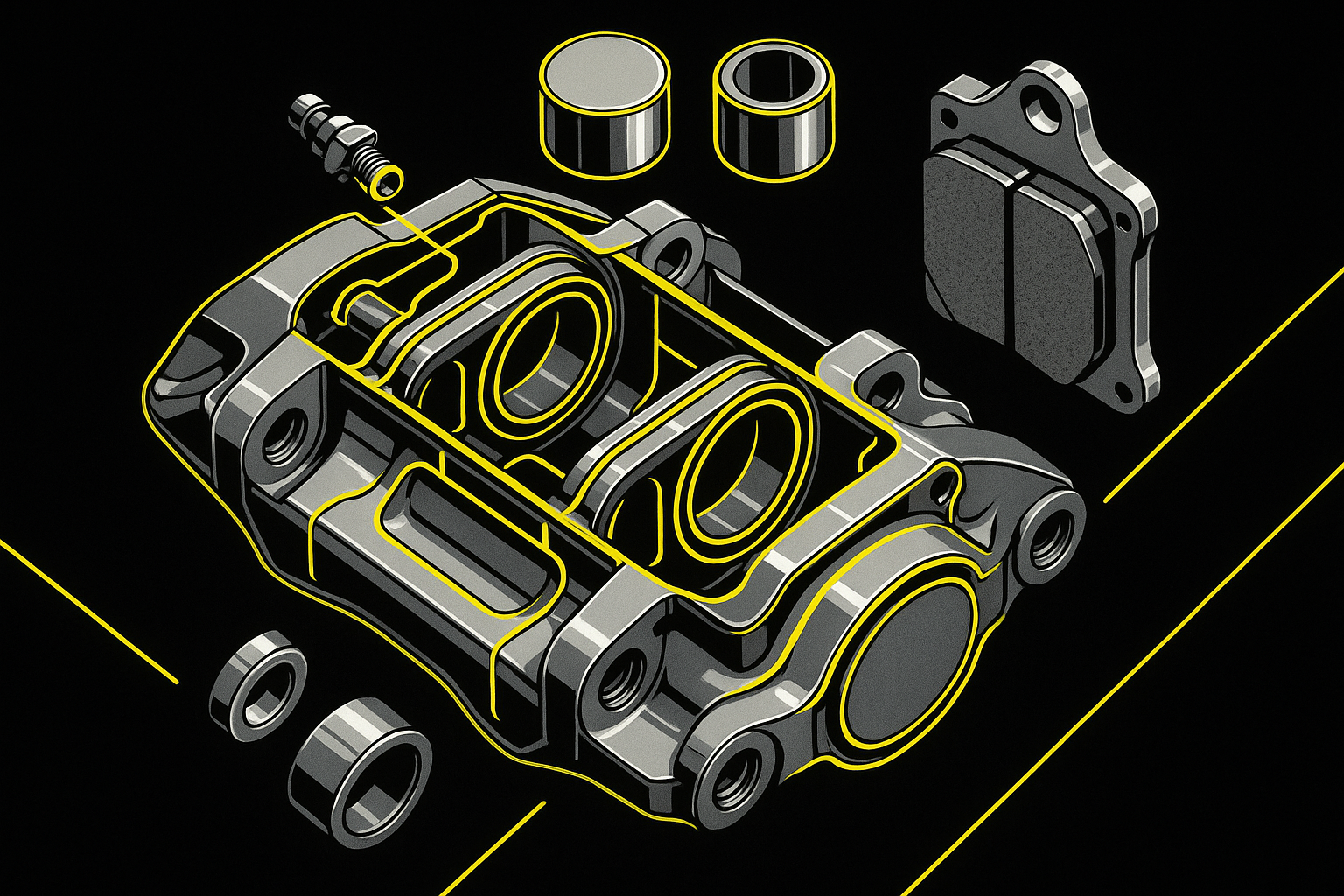
Structurally, a caliper consists of a rigid body — typically aluminium in high-performance applications or cast iron in standard equipment — which houses one or more pistons. When the driver presses the brake pedal, fluid pressure travels through the circuit and pushes the pistons outward, forcing the pads against the disc. When the pedal is released, the rubber seals around the pistons retract them slightly, relieving pressure on the disc and allowing it to spin freely.
The build quality of the caliper directly affects pedal feel, the evenness of pressure distribution across the pad face and resistance to brake fade during sustained hard use. A caliper with a rigid body and well-engineered pistons allows more precise control of the braking point — a key advantage in performance driving, trackday sessions and all forms of motorsport competition.
Types of brake calipers: technical differences and applications
There are two main families of brake caliper: floating calipers and fixed calipers. The differences between them are not merely constructional — they directly affect the dynamic behaviour of the entire braking system. Understanding these differences is the starting point for selecting the most appropriate configuration for any vehicle or use case.
Floating calipers: Also known as sliding calipers, these are the most common type found on production vehicles. The caliper body slides laterally on guide pins or bolts, so the pistons — usually one or two, located on the inboard side — push the inner pad against the disc, while the sliding motion of the body draws the outer pad in from the other side. This design is simpler, less expensive and perfectly adequate for everyday road use, but it has limitations in terms of structural rigidity and thermal resistance under sustained hard braking.
Fixed calipers: The body is rigidly mounted to the upright and does not move. Pistons are arranged symmetrically on both sides of the disc — in configurations of 4, 6 or even 8 pistons — delivering a more even pressure distribution, greater structural stiffness and a more direct pedal response. This is the standard for performance cars, high-performance brake systems and all categories of motorsport. The aluminium monoblock caliper represents the pinnacle of this family, combining minimum weight with maximum rigidity.
Drum-type brake assemblies also exist, still used on the rear axles of some entry-level vehicles and in certain parking brake applications, though their prevalence has declined sharply compared to disc brake systems in recent decades.
Practical applications: choosing the right caliper for your vehicle and use
Selecting the correct brake caliper depends on several factors: the type of vehicle, the level of stress the system will be subjected to, the vehicle's weight, and the characteristics of the disc and pads it will work with. There is no single universal caliper that is optimal in every scenario, which is why understanding the options matters so much.
For a road car used mainly in urban or motorway conditions, a well-maintained floating caliper with one or two pistons, paired with quality brake pads, delivers more than adequate performance. However, as soon as the vehicle is exposed to trackday sessions, sustained hard driving or amateur competition, the floating caliper begins to show its limits: increased sensitivity to fade, uneven pad wear and slower recovery between successive hard stops.
In performance and motorsport applications — rally, circuit, kart, Kartcross or SSV — a fixed caliper with four or more pistons is essentially indispensable. Paired with vented or floating discs and compound-specific pads such as those developed by SDT Brakes for Alcon, AP Racing and Wilwood calipers, the system delivers a level of performance and repeatability that standard equipment simply cannot match. On motorcycles, radial-mount aluminium monoblock calipers with 4 or 6 pistons are the preferred choice for supermoto, circuit and extreme enduro.
Brake caliper maintenance: common mistakes and best practice
A brake caliper in good condition is just as important as having the best pads or the most rigid discs. Poor maintenance is, in the majority of cases, the root cause of braking problems that are mistakenly blamed on other components.
The most common mistake is failing to inspect piston condition and seals after demanding sessions. Extreme heat can degrade the rubber seals, preventing the pistons from retracting correctly. This causes continuous contact between the pad and disc, leading to premature overheating and accelerated wear across the entire braking assembly. In competition use, always visually inspect the pistons and clean the caliper bleed and fluid channels after each event.
Another frequent oversight is not replacing the brake fluid at the recommended intervals. Fluid absorbs moisture over time, which lowers its boiling point and promotes the formation of vapour bubbles in the hydraulic circuit under high heat — a condition that causes a loss of caliper pressure at the worst possible moment. Using a high-temperature synthetic DOT4 fluid and replacing it regularly is one of the simplest and most effective ways to maintain braking performance. Completing the system with stainless steel braided brake lines prevents hose expansion under pressure and significantly improves pedal feel and response.
Understanding how a brake caliper works and which type suits your vehicle is the first step towards a truly optimised braking system. At SDT Brakes you will find brake pads, discs, braided brake lines and accessories engineered to work in perfect synergy with every caliper type — from everyday floating units to full competition monoblock assemblies.
Frequently asked questions
What is the difference between a floating and a fixed brake caliper?
A floating caliper slides laterally on guide pins and only has pistons on one side; the movement of the caliper body presses the outer pad against the disc. A fixed caliper has pistons on both sides of the disc and does not move, delivering a more direct, consistent response that is better suited to high thermal demands.
How many pistons does a brake caliper need for track use?
For trackday and circuit use, a minimum of 4 pistons is recommended. More pistons distribute pressure more evenly across the pad, reduce deflection in the assembly and improve braking point consistency. Six or eight-piston calipers are reserved for dedicated competition where repeatability under extreme heat is critical.
Can I fit a larger brake caliper without changing the disc?
Not necessarily. Fitting a larger caliper means verifying that the disc diameter is compatible and that sufficient clearance exists inside the wheel. In many cases a larger-diameter disc and a specific mounting bracket or adapter are also required. Always consult a specialist before making any modification to your braking system.
When should I inspect or replace my brake caliper?
Common signs of a failing caliper include uneven braking from side to side, vehicle pulling under braking, a soft pedal that does not improve after bleeding, or pistons that fail to retract properly. In motorsport applications, always inspect piston seals and clean caliper channels after each event or track day.
What brake fluid should I use with a high-performance caliper?
A DOT4 or higher specification fluid with a high dry boiling point is strongly recommended. For circuit or rally use, a high-temperature fluid prevents vapour bubbles forming inside the hydraulic circuit — a phenomenon known as vapour lock that causes total brake failure. Replace the fluid according to manufacturer guidelines or after every competition season.
Why SDT Brakes?
Own manufacturingWe design and manufacture our calipers and pads in Europe using premium-grade materials.
Technical supportOur team answers all compatibility and fitting questions at no extra charge.
Fast delivery24-48h shipping to mainland Spain so you never miss a race day or track session.
Trusted customersOver 480 verified reviews with an average rating of 4.8 out of 5.
Easy returns14-day hassle-free returns if the product is not exactly what you needed.
Motorsport provenProducts chosen by professional teams and drivers in rally, kart and circuit racing.
Choose the right caliper and brake with total confidence
Having the right brake caliper makes the difference between a controlled, confident stop and a dangerous loss of braking power. At SDT Brakes you will find the ideal solution for every vehicle and every level of demand, backed by genuine specialist support.
Updated: 20 June 2026