 Español
 English
Shopping Cart
⭐ 4.8/5 (480 verified reviews)24-48h mainland deliveryEU in-house manufacturingFree technical advice
SDT Brakes
Brake Lines: Complete Technical Guide to Types & Materials
Brake lines and hoses are the hydraulic link between the brake pedal and the callipers. Their condition directly determines the precision of every stop: a deteriorated or expansible hose absorbs pressure and turns a firm pedal into a spongy, imprecise response.
This technical guide covers everything you need to know about brake line types, materials, installation and maintenance — with clear criteria for choosing the right solution for your vehicle and intended use.
⭐ 4.8+480 valoraciones
verificadas
verificadas
In-house manufacturingbrake lines built in our own European facility
Certified materialsstainless steel braid with PTFE inner lining
Full compatibilitycar, motorbike, kart, kartcross and special vehicles
24-48h deliveryfast shipping across mainland Spain and EU
What vehicle or application do you need brake lines for?
Which should you choose? Brake line and hose comparison
| Model | Material | Expansion under pressure | Recommended use | Estimated lifespan |
|---|---|---|---|---|
| OEM rubber brake hose | Reinforced rubber | High (expands) | Standard road use | 3-5 years |
| Stainless steel braided PTFE hoseTop choice | Stainless steel + PTFE | Minimal (non-expandable) | Road, sport, circuit | 8-12 years |
| Rigid steel brake pipe | Carbon steel | None (rigid) | Fixed chassis runs | 10-15 years |
| Copper-nickel brake pipe | Cu-Ni alloy | None (rigid) | Restoration and road | 10+ years |
| Nylon braided hose | Nylon + fibre braid | Low-medium | Road and moderate use | 4-6 years |
What are brake lines and brake hoses?
Brake lines and brake hoses form the hydraulic circuit that transmits pressure from the master cylinder to each brake calliper. Without them, the force applied to the pedal or lever would never reach the pistons that press the brake pads against the disc.
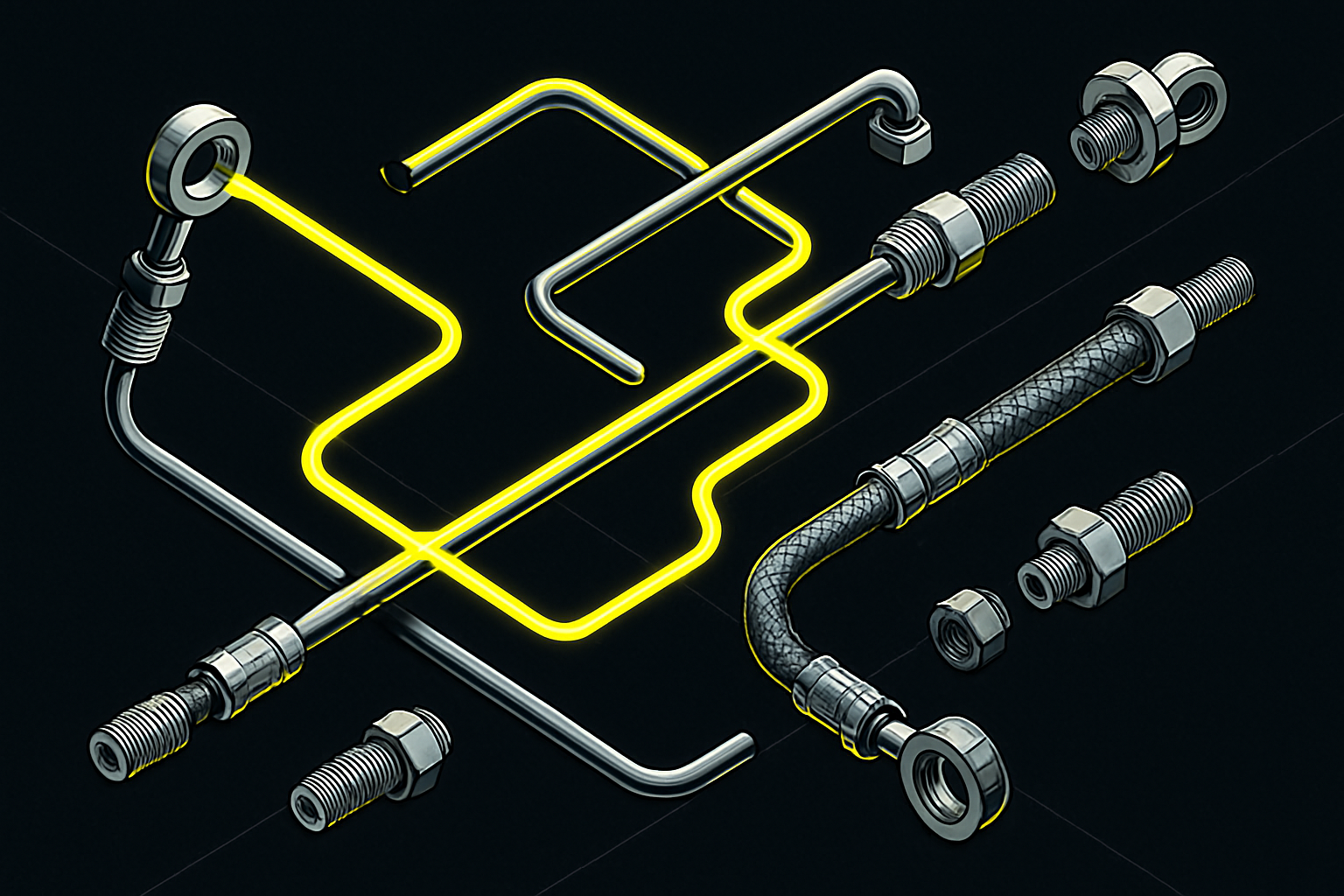
The hydraulic braking circuit combines two types of conduit: rigid brake pipes, which run along the chassis where there is no relative movement between the body and the suspension, and flexible brake hoses, which connect the fixed pipes to the callipers, allowing them to move freely with the wheel through every bump, corner and braking event.
This distinction is fundamental. Brake hoses must withstand repeated flexing without cracking, resist the high temperatures generated during intensive braking and maintain full hydraulic pressure without deforming. A degraded or expandable hose means that any upgrade to brake pads or discs will underperform, because the loss of precision starts before the hydraulic pressure ever reaches the friction components. Fittings and adapters complete the system, ensuring total sealing at every connection point.
Types of brake lines: materials and construction explained
The conventional rubber brake hose, fitted as standard on most production vehicles, is built from layers of vulcanised rubber reinforced with textile braid. It performs adequately under normal use, but its elastic nature makes it susceptible to expansion under high pressure, particularly as the rubber ages and loses rigidity. The result is a softer pedal and less precise modulation.
The stainless steel braided brake hose — also known as an aeronautical hose or PTFE brake line — replaces the textile cover with a braid of AISI 304 stainless steel wire and the rubber inner tube with a PTFE (polytetrafluoroethylene) liner. The steel braid prevents radial expansion of the tube under pressure, while the PTFE lining withstands higher temperatures and is chemically inert to brake fluid, preventing the internal degradation that affects conventional rubber tubes over time.
Rigid brake pipes are manufactured in coated carbon steel (zinc-chromated or PVC-coated), stainless steel or copper-nickel alloy. Copper-nickel pipes stand out for their ease of bending without specialist tools, their corrosion resistance and their longer service life compared with carbon steel. Brake pipe clips and holders keep rigid pipes on their correct routing without vibration or contact with chassis components that could cause wear.
Applications by vehicle type and intended use
On a road-only vehicle, replacing OEM rubber hoses with stainless steel braided brake hoses is one of the most cost-effective safety improvements available. No adjustments to the rest of the system are required, fitment is direct and the result is immediate: a firmer pedal, more progressive braking and a more predictable response in emergency situations. Vehicle-specific kits — available for models such as the VW Golf, BMW 2 Series and Toyota Celica — further simplify the installation process with pre-sized hoses and the correct fittings.
For trackday, clubsport or circuit competition use, braided brake lines are not an optional upgrade but a safety requirement. During repeated high-speed braking events, brake fluid temperature rises significantly. A degraded rubber hose can combine material expansion with partial vapourisation of the fluid, generating a spongy pedal at the worst possible moment. Stainless steel braided hoses with a PTFE lining handle these conditions without compromising pressure transmission.
On motorbikes, the improvement is even more noticeable than on cars, given the shorter lever travel and the rider's greater tactile sensitivity. A braided stainless brake line eliminates the sensation of a lever that sinks before biting and reduces hand fatigue during mountain or circuit riding. For karts and vehicles such as kartcross or UTV, fittings and diameter reducers allow the hydraulic circuit to be adapted to non-standard chassis configurations while maintaining total system integrity.
Maintenance, inspection and common mistakes to avoid
The most common mistake in hydraulic braking system maintenance is overlooking brake hoses when replacing pads and discs. A rubber hose over five years old or with more than 50,000 km may show internal micro-cracks that are invisible from the outside but significantly compromise structural integrity. Visual inspection must cover the full length of each hose, paying particular attention to bends and areas close to heat sources.
Another frequent error is failing to bleed the circuit properly after fitting new brake lines. Any air bubble trapped in the system causes a spongy pedal regardless of the quality of the newly installed braided hoses. Bleeding must be carried out in the sequence specified by the vehicle manufacturer and with fresh brake fluid — such as synthetic DOT4 — taking the opportunity to renew the fluid entirely.
Regarding rigid brake pipe clips and supports, it is advisable to replace them together with the pipe during any circuit repair. Worn clips cause vibration and chafing that can eventually lead to pipe failure. Finally, never mix brake fluids of different DOT specifications without first flushing and cleaning the circuit; chemical incompatibility can damage internal seals and degrade hose linings.
Understanding your hydraulic braking circuit is the first step to keeping it in perfect working order. At SDT Brakes you will find braided brake hoses, rigid brake pipes, fittings, pipe clips and DOT4 brake fluid for all vehicle types, all manufactured in-house and dispatched within 24-48h. Browse the catalogue and contact our technical team if you need guidance — we are here to help.
Frequently asked questions
What is the difference between a stainless steel brake hose and an OEM rubber one?
OEM rubber hoses tend to expand slightly under hydraulic pressure, resulting in a softer pedal feel. Stainless steel braided hoses with a PTFE inner tube are essentially non-expandable, transmitting pressure directly to the calliper and delivering a more precise, progressive braking feel that deteriorates far less over time.
When should brake hoses and lines be replaced?
Brake hoses should be inspected every two years or 40,000 km. Immediate replacement is required if you notice cracks or blistering on the outer cover, brake fluid leaks, a spongy pedal that does not improve after bleeding, or visible hose deformation during hard braking. Rigid brake pipes showing surface corrosion should also be replaced promptly.
Are stainless steel brake hoses road-legal in Europe?
Stainless steel brake hoses manufactured to E-Mark standards with approved fittings are road-legal in most European countries. SDT Brakes road-use hose kits include the necessary documentation to pass technical inspections without issues, provided fitment follows the correct procedure and the hydraulic circuit is bled correctly.
Can I fit braided stainless brake lines to a road motorbike?
Yes, and it is one of the most effective and cost-efficient upgrades available for any motorbike. The improvement in lever feel is immediately noticeable: the lever requires less travel before the brakes bite, modulation becomes more intuitive and hand fatigue is reduced during mountain or track riding. Correct bleeding of the system after fitment is essential.
Which brake fluid should I use when replacing brake lines?
Whenever brake lines are replaced, the entire circuit should be bled and refilled with the fluid specification listed by the vehicle manufacturer, typically DOT4. Taking the opportunity to fully renew the brake fluid eliminates accumulated moisture, maintains the boiling point within safe limits and ensures compatibility with new PTFE-lined hoses.
How long does it take to install a set of braided brake hoses?
An experienced workshop can complete a full four-hose replacement on a car, including bleeding the circuit, in 60 to 120 minutes. On a motorbike the process is similar or quicker depending on access to the fittings. Proper bleeding after installation is mandatory; any trapped air will cause a spongy pedal regardless of hose quality.
Why SDT Brakes?
In-house productionEuropean manufacturing with quality control at every stage of the process.
Premium materialsGrade 304 stainless steel braid over a heat-resistant PTFE inner tube.
Fast deliveryDispatched within 24-48h to mainland Spain; own-stock availability confirmed.
Technical supportSpecialist advice before and after your purchase, always free of charge.
Easy returns14-day return window with no complications and no hidden conditions.
Proven trustOver 480 reviews averaging 4.8 out of 5 from genuine customers.
Upgrade your braking system with SDT Brakes today
Whether you need greater safety on public roads or the sharpest possible response on track, SDT Brakes has the right braided brake hose kit or rigid brake pipe for your vehicle. In-house European manufacturing, 24-48h dispatch and genuine technical support from people who know brakes.
Updated: 20 June 2026