 Español
 English

Shopping Cart
⭐ 4.8/5 (480 verified reviews)24–48h shipping to mainland SpainOwn EU manufacturingFree technical advice
SDT Brakes
ABS Brake System: how it works, components and fault diagnosis
The ABS brake system (Antilock Braking System) is one of the most significant active safety advances in motoring history. Its purpose is to prevent wheel lock-up during emergency braking, allowing the driver to maintain directional control even in extreme situations.
This technical guide covers everything you need to know about ABS: its components, how it acts on the hydraulic circuit, the symptoms that indicate a fault, and which brake system parts directly influence its correct operation.
⭐ 4.8+480 valoraciones
verificadas
Expert technical guideclear, rigorous explanation of how ABS works
Fault diagnosisidentify common failures before visiting a workshop
Key componentsunderstand each part and its role in the circuit
Real applicationscars, motorbikes and high-performance vehicles
Which ABS system component do you need to check or upgrade?
Comparison of key ABS system components
| Model | Role in ABS | Recommended part | Safety impact | Replacement difficulty |
|---|---|---|---|---|
| Wheel speed sensor | Sends signal to ABS ECU | OEM-spec speed sensor | Critical — activates/deactivates ABS | Medium |
| ABS reluctor ring (tone wheel)Top choice | Generates pulses for sensor | Disc with integrated ABS ring | Critical — speed reading accuracy | Medium–high |
| ABS hydraulic modulator | Regulates pressure per circuit | Hydraulic repair kit | Very high — core of the system | High |
| DOT4 brake fluid | Transmits hydraulic pressure | Synthetic DOT4 fluid 240° | High — hygroscopic, degrades ABS | Low |
| Braided steel brake hoses | Carry fluid without expansion | Stainless steel hose kit | Medium–high — precise response | Low–medium |
| ABS control unit (ECU) | Processes signals and acts | ECU repair or replacement | Very high — system brain | High |
What is the ABS system and what are its components?
The ABS system, short for Antilock Braking System, is an electronic active safety system fitted to virtually every vehicle manufactured in Europe since 2004, when it became mandatory under EU regulations. Its core purpose is to prevent wheel lock-up during hard braking, ensuring the driver retains the ability to steer even under maximum pedal pressure.
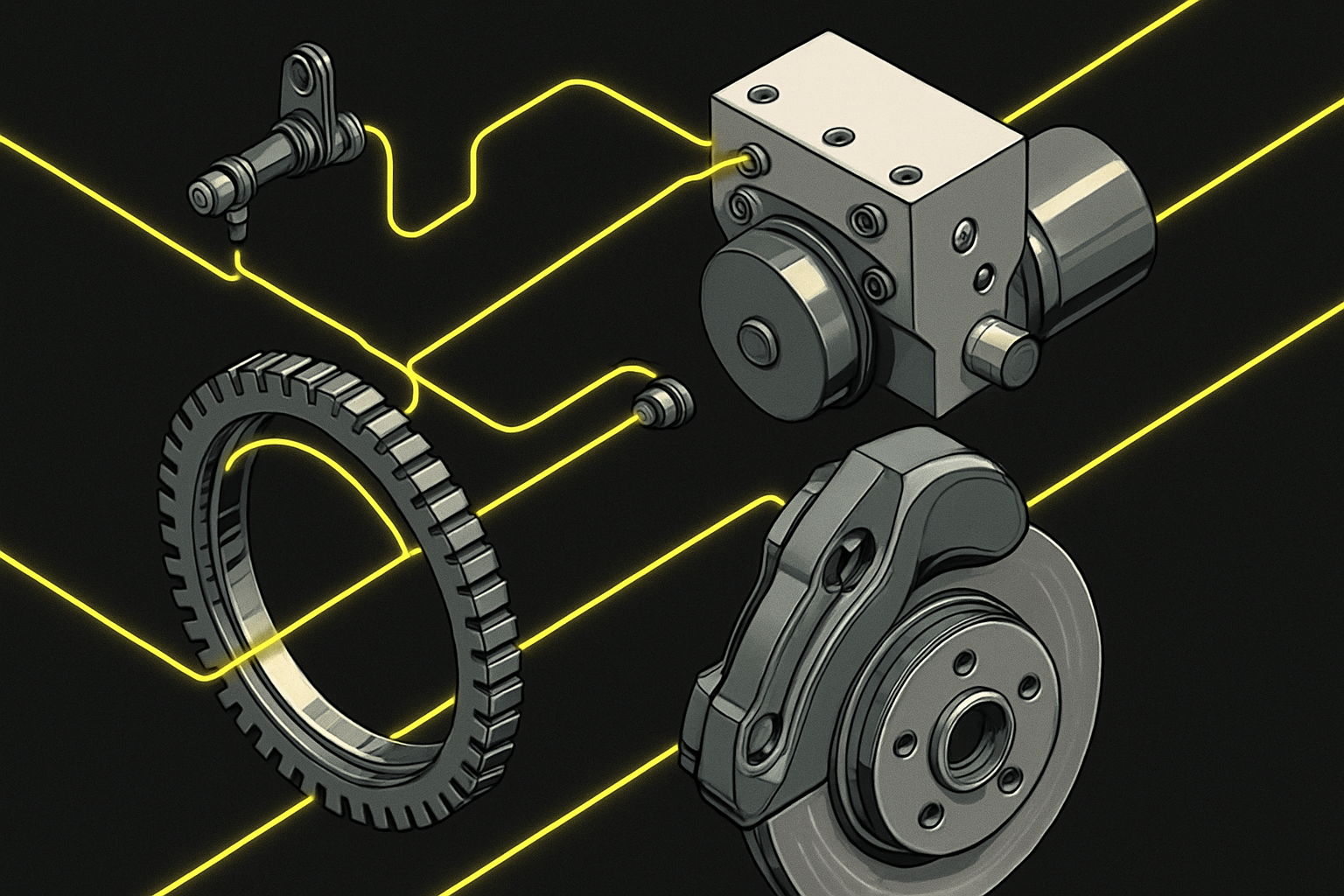
The system comprises four main elements working in coordination. First, the wheel speed sensors—typically Hall-effect or inductive type—continuously monitor the rotational speed of each wheel and send that data in real time to the control unit. Second, the reluctor ring (tone wheel), usually integrated into the hub or the brake disc itself, generates the magnetic pulses the sensor reads. Third, the ABS hydraulic modulator, made up of solenoid valves, a return pump and a pressure accumulator, autonomously regulates brake fluid pressure in each circuit. Finally, the ABS electronic control unit (ECU) processes all signals, detects the onset of lock-up and issues corrections within milliseconds.
Understanding each component's function is the essential first step to diagnosing faults correctly and selecting the right replacement parts. Components such as brake fluid, braided steel hoses and brake discs with ABS rings directly influence system effectiveness, making their quality and maintenance critical for vehicle safety.
How does ABS work: the pressure modulation cycle step by step
The ABS system operates on a pressure modulation cycle that can repeat up to 20 times per second per wheel. When the driver applies hard braking, the ABS ECU compares the speed signals from all four wheels. If it detects that one wheel is decelerating significantly faster than the others—a clear sign it is about to lock—it immediately activates the intervention cycle.
This cycle consists of three distinct phases. In the pressure reduction phase, the inlet solenoid valve closes and the outlet valve opens, releasing pressure in that wheel's circuit and preventing complete lock-up. The released brake fluid passes into the low-pressure accumulator. In the hold phase, both valves remain closed, maintaining pressure at exactly the right level to keep the wheel rotating at the limit of grip. In the pressure increase phase, the return pump feeds fluid back into the circuit and the inlet valve reopens progressively, building braking pressure again until the sensor detects a new lock-up risk and the cycle restarts.
Drivers experience this process as a characteristic pulsation or vibration in the brake pedal—this should not be mistaken for a mechanical fault; it is the sign that ABS is working correctly. The quality of DOT4 brake fluid is critical at this point: a degraded fluid with high water absorption can generate steam bubbles in the hydraulic modulator, compromising the speed and accuracy of pressure modulation.
ABS applications: from urban driving to motorsport
The ABS system originated in aviation during the 1950s before making its way into production cars at the end of the 1970s. Today its presence extends far beyond the standard family car. On motorcycles, ABS statistically and significantly reduces accidents caused by loss of control during braking, particularly on mixed or sandy surfaces. EU regulations have required it on all motorcycles above 125 cc since 2016.
In the context of performance driving and trackdays, the relationship with ABS is more nuanced. Some experienced drivers choose to disable it on circuit to exploit the full grip limit of the tyre, while for less experienced track drivers ABS remains an essential safety tool. In either case, the condition of associated components is decisive: braided steel brake hoses ensure loss-free pressure transmission that the ABS modulator can manage with greater precision, while brake discs in good condition with an intact reluctor ring provide reliable sensor readings.
In competition vehicles such as rally or hillclimb cars, ABS may be homologated or restricted depending on the regulations of each category. In these cases, selecting racing brake discs compatible with the original ABS ring—such as those SDT Brakes offers for specific models—allows the system's functionality to be retained without sacrificing competition-level braking performance. Cut-Moon design discs, for example, combine heat and gas evacuation with ABS ring integration for sport and semi-competition use.
ABS maintenance and common mistakes to avoid
ABS maintenance does not generally require independent servicing, but it does depend on correct upkeep of the overall braking system. The most common mistake is neglecting the periodic replacement of brake fluid: as a hygroscopic fluid, it absorbs moisture from the atmosphere through the hoses and reservoir, lowering its boiling point and potentially affecting the ABS hydraulic modulator's behaviour. Checking water content annually and replacing the fluid at least every two years is strongly recommended.
Another frequent error is overlooking the condition of the reluctor ring when replacing brake discs. If the new disc is fitted without verifying that its reluctor ring is intact, the sensor may produce erroneous readings and trigger the ABS warning light even when no electronic fault actually exists. Similarly, contamination between the sensor and the ring—oil, compacted mud or brake pad dust—is one of the most common causes of ABS fault codes that can be resolved simply by careful cleaning.
Finally, it is worth noting that fitting braided steel hoses in place of the original rubber ones never interferes with ABS operation—on the contrary, it enhances it by providing more linear and precise pressure transmission. Provided the original circuit fittings and bore sizes are respected, the replacement is straightforward and beneficial for the vehicle's active safety.
An ABS system is only as effective as the components around it. Keeping brake fluid in good condition, discs with an intact reluctor ring and hoses in perfect order is the best guarantee that ABS will perform as designed. At SDT Brakes you will find all these components backed by included expert technical advice.
Frequently asked questions
What is the ABS brake system and what exactly does it do?
ABS (Antilock Braking System) is an electronic active safety system that prevents wheel lock-up during hard braking. By avoiding tyre slip, the driver retains steering ability and can avoid obstacles, significantly reducing stopping distances on wet or low-grip surfaces.
What are the most common symptoms of an ABS fault?
The most frequent symptoms are the ABS warning light illuminating on the dashboard, loss of the characteristic pedal pulsation during emergency braking, unusual noises when braking, and in severe cases a general reduction in braking effectiveness. A faulty wheel speed sensor or a broken reluctor ring are the most common causes.
Can brake fluid affect how the ABS system performs?
Yes, directly. Brake fluid is hygroscopic and absorbs moisture over time, lowering its boiling point. In the ABS hydraulic modulator, which generates very rapid pressure variations, degraded fluid can produce vapour and reduce effectiveness. Replacement is recommended every two years or when water content exceeds 3%.
Are braided steel brake hoses compatible with ABS-equipped vehicles?
Absolutely. Braided steel brake hoses are fully compatible with any modern ABS system. Being non-expandable, they improve hydraulic circuit response and provide a firmer, more precise pedal feel. This does not interfere with the ABS modulator function, which operates upstream in pressure management.
How do you diagnose a faulty ABS wheel speed sensor?
The most reliable diagnosis uses an OBD2 scanner to read fault codes from the ABS module, pinpointing the exact sensor with the issue. You can also check manually by measuring sensor resistance with a multimeter or visually inspecting the brake disc's reluctor ring for broken teeth or built-up contamination.
What happens if I drive with the ABS warning light on?
The vehicle will still brake, but without the ABS electronic assistance. In normal driving conditions the risk is limited, but in an emergency stop on wet or low-grip surfaces the risk of lock-up and loss of control increases considerably. It is strongly advisable to diagnose and repair the fault as soon as possible.
Why SDT Brakes?
Technical supportBrake-specialist engineers answer your questions free of charge.
Fast deliveryReceive your components within 24–48h anywhere on the Spanish mainland.
Own manufacturingDesigned and produced in Europe under strict quality controls.
Top-ratedOver 480 customers rate us 4.8 out of 5 on average.
Easy returns14-day hassle-free returns. Your purchase is always protected.
SDT Brakes: experts in every braking system component
From high-performance DOT4 brake fluids to brake discs with integrated ABS rings, SDT Brakes stocks everything you need to keep your braking system in perfect condition. Our technical team is ready to guide you with professional, no-cost advice whenever you need it.
Updated: 20 June 2026