 Español
 English

Shopping Cart
⭐ 4.8/5 (480 verified reviews)24-48h dispatch mainland SpainEU own-brand manufacturingFree specialist technical advice
SDT Brakes
ABS System: components, how it works and braking distance explained
The ABS system — Antilock Braking System — is one of the most significant active safety advances of the last four decades. Its core function is to prevent wheel lock-up during emergency braking, allowing the driver to retain directional control even in the most demanding situations.
In this technical guide by SDT Brakes you will find everything you need to know: components, operating principles, real-world limitations and how to get the most from your brake system working in synergy with ABS.
⭐ 4.8+480 valoraciones
verificadas
Technical guideclear explanation of every ABS component
Real-world applicationhow ABS affects stopping distance
Brake compatibilitychoose components that enhance ABS performance
Expert adviceSDT technicians available for your questions
Which brake component do you want to upgrade on your ABS-equipped vehicle?
How do brake systems compare by ABS compatibility?
| Model | ABS Compatibility | Vehicle type | Usage level | Main advantage |
|---|---|---|---|---|
| Slotted discs with integrated ABS ringTop choice | Full — ring integrated | Saloon / Sport | Road & trackday | Clean signal to ABS sensor |
| Standard OE smooth discs | Standard | Saloon | Daily driving | Lower cost |
| Aftermarket drilled discs | Compatible if ring is retained | Sport / GTI | Spirited road use | Better thermal dissipation |
| Racing brake pads | Compatible | Competition / Trackday | Track & rally | Higher friction coefficient |
| Stainless steel braided hoses | Compatible, improves response | Universal | Road / Track | More precise brake feel |
| DOT 5.1 brake fluid | Compatible — high boiling point | Universal | Trackday / High temperature | Prevents vapour lock on long stops |
What is the ABS system and where did it come from?
The ABS system — Antilock Braking System — is an active safety device that prevents a vehicle's wheels from locking up completely during hard braking. When a wheel locks, it loses traction with the road surface and the driver loses the ability to steer, which can lead to a collision even with the brakes fully applied.
The underlying principle was patented in the first half of the twentieth century for aviation use, but it did not reach production cars until the late 1970s, when manufacturers such as Bosch and Mercedes-Benz began fitting it to high-end models. From there, adoption grew steadily until the European Union made it mandatory on all new passenger cars from 2004 and on motorcycles over 125 cc from 2016.
Today ABS is the foundation upon which more advanced systems are built: electronic stability control (ESC), traction control (TCS) and autonomous emergency braking (AEB). Understanding how ABS works is therefore understanding the basis of modern active safety in any motor vehicle.
ABS system components and how they work together
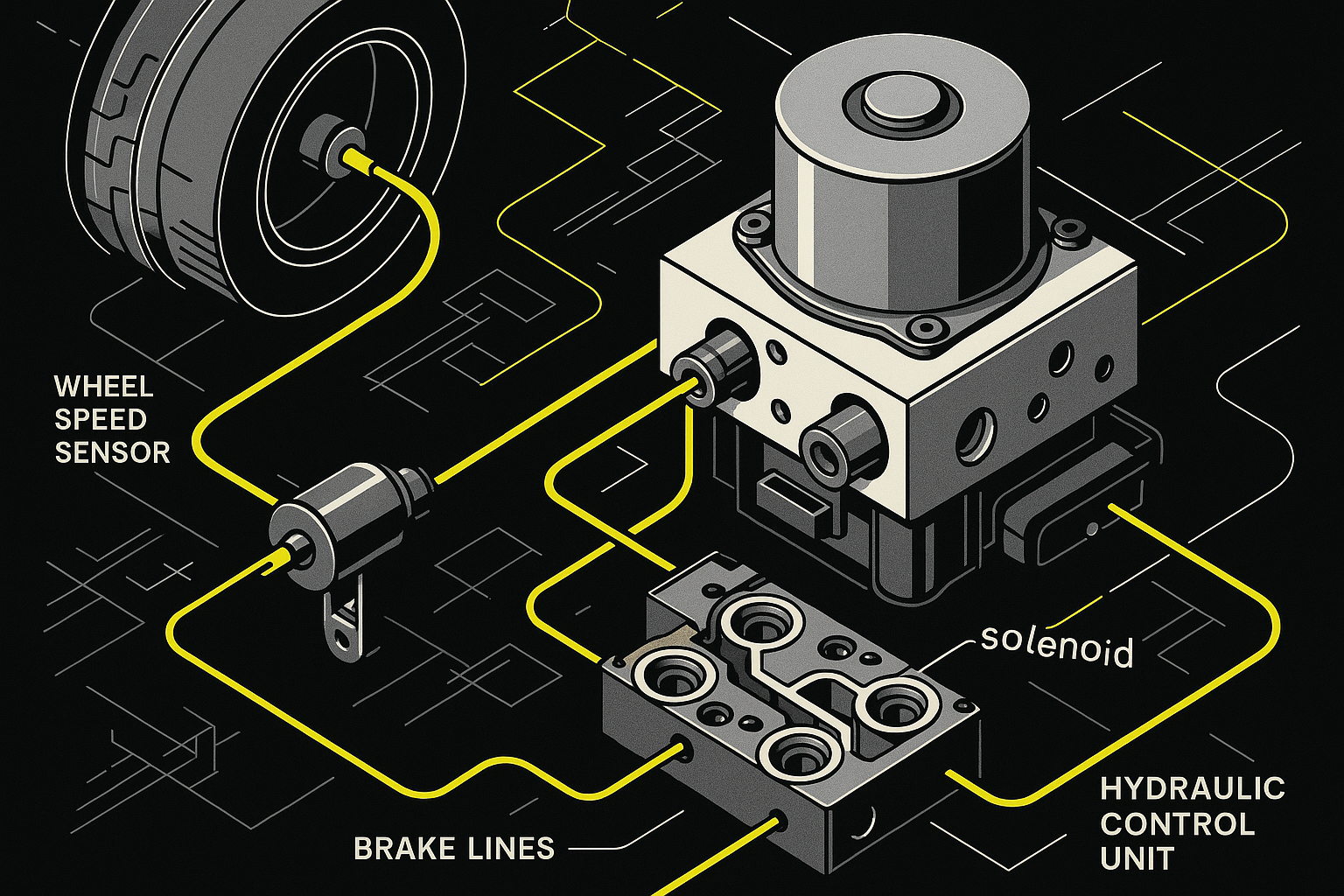
The ABS system comprises four main elements that operate in a continuous cycle during every hard stop. The first is the wheel speed sensor, also called the ABS sensor or reluctance sensor, which is mounted near the hub or brake disc and reads rotational speed through a toothed ring called the reluctor or tonewheel. Each wheel has its own dedicated sensor, enabling individual and independent management.
The second component is the electronic control module (ABS ECU), the brain of the system. It receives signals from all four wheel sensors in real time and detects when one wheel is decelerating sharply relative to the others — a clear sign it is about to lock. This processing happens in milliseconds, far faster than any human reaction.
The third element is the hydraulic modulator, made up of solenoid valves and a return pump. When the ECU detects a lock-up risk, the valves reduce hydraulic pressure in the affected wheel's circuit; once the wheel recovers grip, pressure rises again. This pressure-increase and pressure-release cycle can repeat between 10 and 20 times per second, creating the characteristic pulsation felt through the brake pedal during an emergency stop.
The fourth component is the vehicle's brake hardware itself: discs, pads and callipers. The quality and condition of these parts largely determine real-world ABS effectiveness. A warped disc, worn pads or leaking hoses compromise system response even if the electronics are functioning perfectly. Keeping brake components in optimal condition is therefore just as important as the correct operation of the control unit.
ABS in practice: road, sport and competition driving
In urban and everyday road use, ABS acts as an invisible safety net. Most drivers never consciously activate it, yet in an emergency stop to avoid an unexpected hazard the difference between steering clear and colliding can come down to those milliseconds in which the system regulates braking pressure wheel by wheel. ABS is particularly effective on wet tarmac, variable surfaces or when the four wheels have different grip coefficients — a common situation in corners with standing water.
In spirited and trackday driving the relationship with ABS is more nuanced. Experienced drivers learn to bring the brake to the lock-up threshold without triggering it, because a smooth, controlled stop is more efficient on circuit than the rapid ABS cycles of a standard system. However, the high-performance ABS systems fitted to vehicles such as the Renault Megane III RS or the Volkswagen Golf GTI offer specific track braking maps that allow more aggressive inputs without sacrificing stability.
In rally competition or kartcross events, ABS use depends on the regulations of each category. Many entry-level classes expressly prohibit ABS to level the playing field. In those contexts, the intrinsic quality of slotted discs, racing-compound pads and braided hoses takes centre stage because the driver must manage the lock-up threshold manually. SDT Brakes stocks components for both scenarios, whether the vehicle runs ABS or not.
For special vehicles such as UTVs, SSVs or karts, ABS is not common but the brake mechanics remain the same. Correct pressure modulation, pad compound selection and disc condition determine braking distance regardless of any electronics. In these vehicles, choosing quality components is the only substitute for electronic anti-lock.
ABS maintenance: common mistakes and best practice
The most common mistake when dealing with ABS is assuming that if the warning light is off, the system is working correctly. Wheel speed sensors accumulate dirt and corrosion over time, especially in damp climates or on vehicles driven on dirt tracks. Periodic cleaning of the reluctor ring and the sensor face is sufficient to prevent false readings that trigger fault warnings.
Another frequent error is fitting aftermarket discs without verifying that the OE or integrated ABS ring is compatible with the existing sensor. If the number of reluctor teeth does not match the sensor's calibration, the ECU will receive incorrect speed signals and may activate ABS at inappropriate moments — or leave it inactive when it is needed most. Before changing discs on ABS-equipped vehicles, always confirm toothed-ring compatibility.
Brake fluid deserves special attention on ABS-equipped vehicles because the hydraulic modulator operates at higher pressures and more frequent cycles than a conventional system. Degraded fluid with a high water content can cause cavitation in the return pump and reduce the system's modulation capacity. Renewing brake fluid at the manufacturer's specified interval is recommended — on track or trackday use this may mean annually. A DOT 5.1 fluid with a high boiling point provides ample safety margin under these conditions.
Finally, if you are fitting braided stainless steel hoses to replace the original rubber lines, ensure they are homologated for road use in your country. Steel-braid hoses improve pedal response and ABS modulation precision, but must be installed without tension or forced bends to avoid fatigue points. Correct fitting guarantees years of reliable operation without compromising the hydraulic circuit.
An ABS system is only as effective as the brake components surrounding it. Discs in good condition, pads with the right compound and hoses that transmit pressure accurately are the foundation for the electronics to do their job properly. Browse the SDT Brakes catalogue and find the components best suited to your vehicle and driving style.
Frequently asked questions
Does the ABS system always reduce braking distance?
Not necessarily on every surface. ABS reduces braking distance primarily on wet tarmac and surfaces with variable grip, because it prevents lock-up and keeps active traction. On loose gravel or compact snow, a locked wheel can form a wedge that shortens the distance; in those cases ABS may slightly extend stopping distance, though always in exchange for maintaining steering control.
Which ABS sensor is compatible with aftermarket brake discs?
Compatibility depends on whether the disc or hub retains the toothed ring (reluctor) with the same number of teeth and diameter as the original. Some quality aftermarket discs include an integrated ABS ring or allow reuse of the original. Always check the disc data sheet or contact SDT Brakes technical support before fitting.
How do I know if my car's ABS is failing?
The clearest indicator is the ABS warning light on the dashboard staying on after start-up. Other symptoms include unusual pedal pulsation during normal braking, excessive vibrations without emergency braking, or mechanical noises from the wheels. Check the wheel sensors, the control module and the condition of the disc toothed ring if any of these appear.
Do braided stainless steel hoses improve ABS performance?
Yes, indirectly but noticeably. Braided hoses eliminate the expansion of rubber lines under pressure, delivering a more linear and predictable pedal response. This increased hydraulic stiffness allows the ABS module to modulate its pressure-release cycles with greater precision, improving control feel during emergency stops.
Why SDT Brakes?
Own manufacturingComponents designed and built in Europe with in-house quality control.
Fast dispatch24-48h delivery on mainland Spain so your workshop never waits.
Technical supportOur engineers answer ABS compatibility questions at no charge.
Verified qualityAverage rating of 4.8 out of 5 from drivers and professional workshops.
Easy returns14-day hassle-free returns if the product does not suit your application.
Brake smarter: SDT components built for ABS systems
Choosing the right discs, pads and hoses makes the difference between an ABS system working at full potential and one fighting against inadequate components. At SDT Brakes you will find everything you need with real expert advice, 24-48h dispatch and EU own-brand quality assurance.
Updated: 20 June 2026