 Español
 English
Shopping Cart
⭐ 4.8/5 (480 verified reviews)24–48 h mainland deliveryEU own manufactureFree technical support
SDT Brakes
ABS Brake System: How It Works, Benefits & Common Faults
The ABS braking system is one of the most significant active safety advances in modern vehicles. By preventing wheel lock-up during emergency braking, it allows the driver to maintain steering control even in the most critical conditions.
At SDT Brakes we have years of hands-on experience with high-performance braking systems and understand exactly how ABS interacts with every other component in the circuit. This guide answers the most common questions with technical accuracy and plain language.
⭐ 4.8+480 valoraciones
verificadas
verificadas
Brake specialistsown catalogue for car, motorbike, kart and more
Free technical adviceexpert guidance before you buy
EU own manufacturecomponents designed and built in Europe
24–48 h mainland deliveryyour brakes when you need them
Which braking component do you need to replace or upgrade?
Which option suits you? Comparison of braking setups by use case
| Setup | ABS | Directional control | Stopping distance | Maintenance |
|---|---|---|---|---|
| Conventional brakes (no ABS) | None | Lost on lock-up | Shorter on dry tarmac | Basic |
| Standard ABS (urban use) | Yes, standard | Preserved in emergency | Reduced on wet roads | Periodic check |
| ABS + EBD (electronic brake distribution)Top choice | Yes + EBD | Optimal in all conditions | Reduced in all conditions | Periodic check |
| ABS + high-performance brake pads | Yes | Very high | Minimal with quality pads | Higher frequency |
| ABS with stainless steel brake lines | Yes | High + precise pedal feel | Reduced with precision | Low (long-lasting lines) |
What ABS is and why it is central to every braking system
ABS — Anti-lock Braking System — was developed to solve one of the most dangerous situations in emergency braking: wheel lock-up. When a wheel locks, the vehicle loses the ability to be steered because the tyre is no longer rolling but sliding. ABS prevents this by automatically modulating hydraulic pressure to keep each wheel at the threshold of maximum grip.
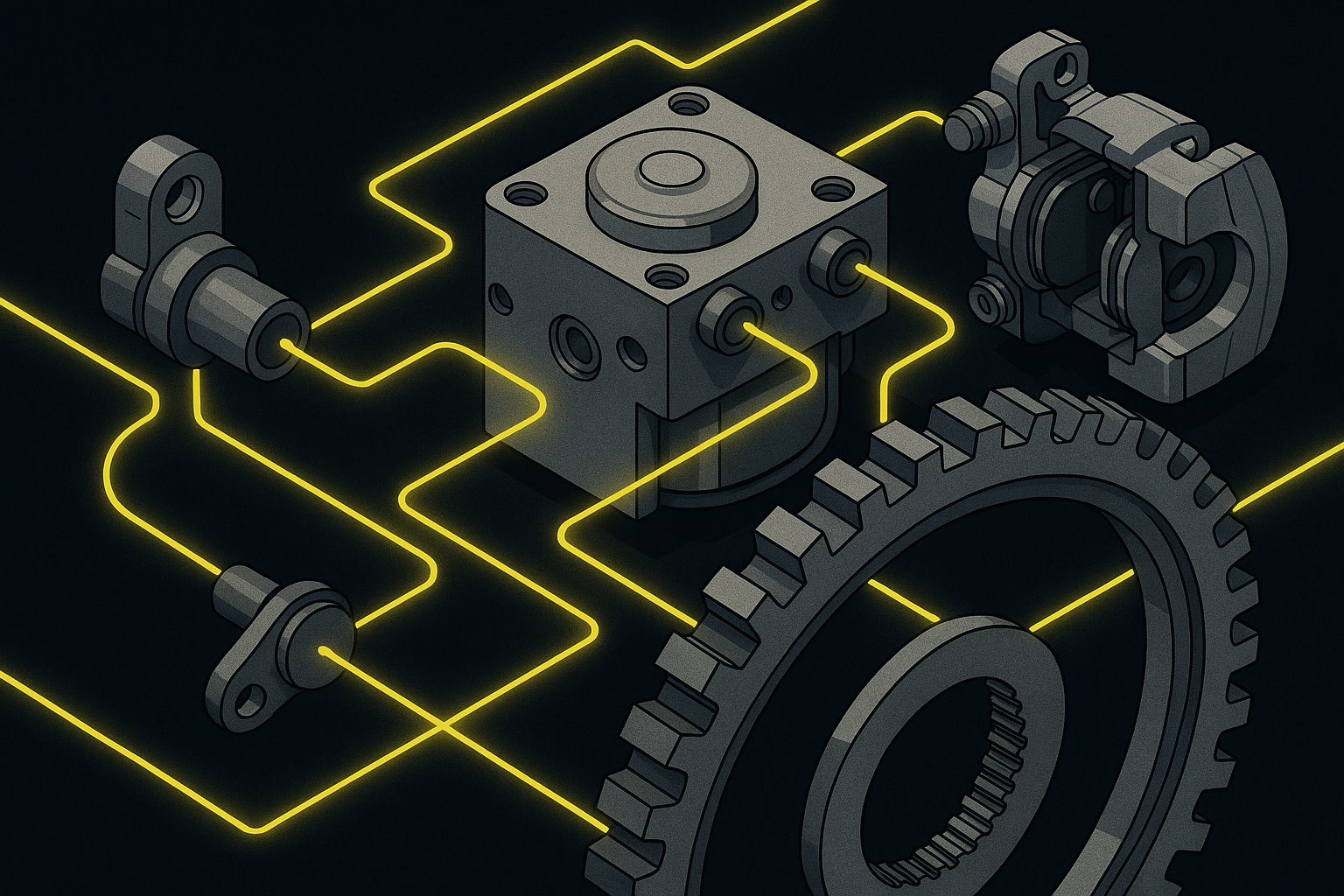
The system comprises four main elements: the wheel-speed sensors, the ABS tone ring (or crown), the hydraulic control unit (ABS module) and the electronic control unit (ECU). All four work in coordination within milliseconds to make every stop as effective as possible while preserving directional control. Today ABS is mandatory on all new passenger cars sold in the European Union and forms the foundation on which other systems — EBD, ESP, traction control — are built.
How to keep your ABS system in perfect working order
Maintaining the ABS system is closely tied to general brake system upkeep. The first element to monitor is the wheel-speed sensors: accurate readings depend on the ABS ring being in good condition and on there being no dirt, mud or corrosion built up around the sensor area. Every time the brake discs or pads are changed, it is worth inspecting the ABS ring and cleaning the sensor.
The second critical factor is brake fluid. Degraded or moisture-contaminated fluid can cause corrosion inside the ABS module's valve block — one of the most expensive faults to put right. Using a quality DOT4 fluid and replacing it every two years is the single most effective preventive measure. Finally, if the ABS warning light illuminates without an obvious cause, connecting a diagnostic scanner before assuming a serious fault is always the right first step: in many cases a simple sensor clean or ABS ring replacement is all that is needed.
SDT Brakes has been supplying braking components to private customers, workshops and competition drivers across Europe for over a decade. Our brake discs with integrated ABS rings, stainless steel brake lines and own-manufacture DOT4 fluids are engineered to work together and deliver maximum safety and performance. If you have any questions about compatibility with the ABS system on your vehicle, our technical team is on hand to advise you free of charge.
Frequently asked questions
How does an ABS brake system work step by step?
ABS (Anti-lock Braking System) uses wheel-speed sensors to detect when any wheel is about to lock up. At that point the control unit modulates the hydraulic pressure in the brake circuit dozens of times per second — alternately releasing and reapplying pressure — to keep the wheel spinning just below the lock-up threshold. This preserves steering ability throughout the braking event.
What are the main advantages of ABS brakes?
ABS delivers three core benefits: it maintains steering control during emergency stops, shortens stopping distances on wet or low-grip surfaces, and significantly reduces the risk of skidding. When combined with systems such as EBD or ESP, the overall active safety of the vehicle improves dramatically compared to a conventional non-ABS setup.
What are the most common ABS faults and how do I spot them?
The most frequent issues are: a dirty or damaged wheel-speed sensor, a worn or broken ABS ring, an electronic fault in the control module, and degraded or low-level brake fluid. The first sign is usually the ABS warning light appearing on the dashboard. In some cases you may also notice an unusual pedal feel or inconsistent braking behaviour at low speeds.
Can the ABS ring be replaced without changing the brake disc?
It depends on the design. On many vehicles the ABS ring is integrated into the hub or wheel bearing and can be replaced independently. On others the ABS tone ring is built directly into the brake disc, as is the case with certain SDT Brakes rear discs that come with the bearing and ABS ring already included. Always check your vehicle's technical documentation before ordering replacement parts.
Which brake fluid should I use in a car with ABS?
Vehicles fitted with ABS need a fluid that retains its boiling point and lubricating properties even under rapid modulation cycles. A quality DOT4 fluid guarantees a minimum dry boiling point of 240 °C, the right viscosity, and the corrosion protection required for the ABS module's valve assembly. Replacing it every two years — or as specified by the manufacturer — is essential preventive maintenance.
Do stainless steel brake lines negatively affect ABS operation?
Not at all. Stainless steel brake lines are non-expansive, which means they transmit hydraulic pressure more accurately and rapidly than rubber hoses. This improves pedal feel and response without interfering with the pressure modulation carried out by the ABS module. In fact, for track day or performance road use, quality stainless brake lines complement ABS operation rather than conflicting with it.
Can ABS be disabled for track or competition use?
On some dedicated competition or track-configured vehicles it is possible to inhibit ABS via a switch or ECU reprogramming. However, on vehicles used on public roads this is not recommended and may be illegal. For mixed road-track use the best approach is to optimise the braking components — pads, discs and fluid — so that ABS intervention is minimised on circuit without ever compromising safety on the road.
How often should the ABS system be inspected?
The ABS system itself requires no dedicated servicing beyond checking the sensor and ABS ring condition whenever discs or pads are changed. The most important maintenance task is keeping the brake fluid in good condition, as degraded fluid can corrode the internal valves of the ABS module — one of the costliest faults to repair. A full brake system check every two years or 40,000 km is a sensible guideline for most drivers.
Why SDT Brakes?
Own manufactureWe design and produce our brake components in Europe using premium-grade materials.
Fast deliveryReceive your brakes within 24–48 h on the mainland — ideal for workshops and racers alike.
Technical supportOur specialists advise on ABS compatibility at no extra charge, before and after purchase.
Outstanding rating4.8 out of 5 across more than 480 genuine reviews from customers across Spain and the EU.
Easy returns14-day hassle-free returns if the product is not exactly what you needed.
ABS-compatible brake components, ready to ship today
From brake discs with integrated ABS rings to synthetic DOT4 fluid and precision stainless steel lines, SDT Brakes stocks everything you need to keep your braking system at its best. Order before midday and receive your parts within 24–48 h, backed by free expert support throughout.
Updated: 20 June 2026