 Español
 English

Shopping Cart
⭐ 4.8/5 (480+ verified reviews)24-48h delivery mainland SpainOwn EU manufacturingFree technical advice
SDT Brakes
Brake disc: types, materials and how to maintain them
The brake disc is one of the most critical components in any braking system. Its role is to convert the vehicle's kinetic energy into heat through friction with the brake pads, slowing the car in a controlled and progressive manner.
In this technical guide you will find everything you need to know: how a brake disc works, which type suits your driving style, what materials are available, and how to extend its service life with proper maintenance.
⭐ 4.8+480 valoraciones
verificadas
In-house manufacturingdiscs designed and produced in Europe under SDT quality control
Wide compatibilitycars, motorbikes, karts, bicycles and special vehicles
Full rangeplain, Cut-Moon slotted, drilled and two-piece bimetallic discs
Technical supportspecialists to help you choose the right disc for your vehicle
What type of brake disc do you need for your vehicle?
Which one to choose? Brake disc type comparison
| Model | Surface design | Recommended use | Heat dissipation | Pad wear |
|---|---|---|---|---|
| Plain OEM disc | None | Daily road use | Medium | Minimal |
| Sport OEM+ plain disc | None / reinforced vanes | Sport road driving | Medium-high | Low |
| Cut-Moon slotted discTop choice | Uniform Cut-Moon slots | Sport, trackday, rally | High | Moderate |
| Drilled disc | Through drillings | Sport road, wet conditions | High | Moderate-high |
| Two-piece bimetallic disc | Optional slots or plain | Competition, high temperatures | Very high | Variable |
| Carbon-ceramic disc | Plain or slotted | Supercars and extreme motorsport | Maximum | Low (special pad required) |
What is a brake disc and what does it do?
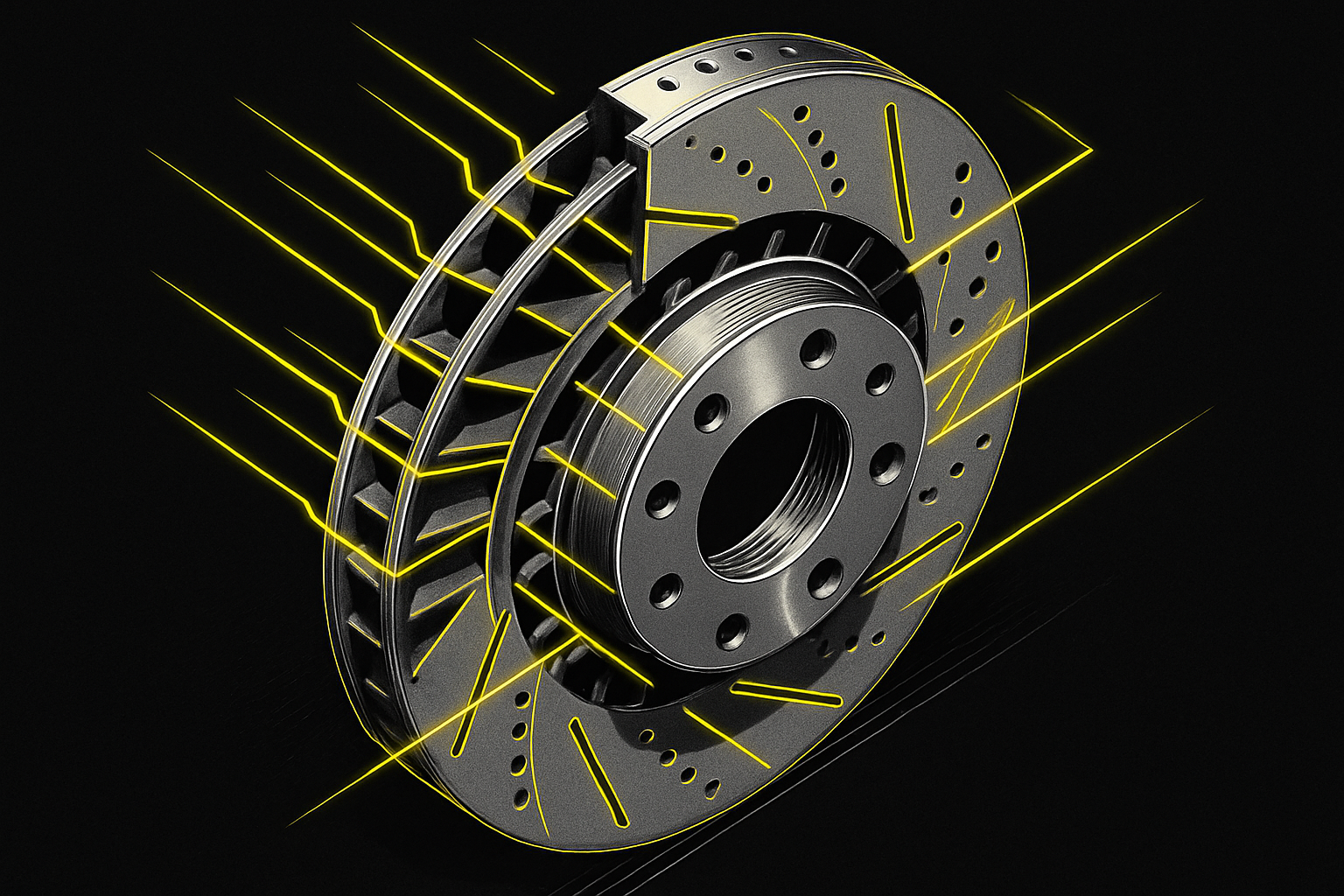
The brake disc, also known as a brake rotor, is a rotating component fixed to the wheel hub that forms part of the disc braking system. When the driver applies the brake pedal, hydraulic pressure pushes the caliper pistons outward, squeezing the brake pads against both faces of the disc. The resulting friction generates heat and converts the vehicle's kinetic energy into thermal energy, bringing it to a controlled stop.
Unlike drum brakes, the disc is fully exposed to the surrounding airflow, which greatly aids heat dissipation and allows consistent braking even after repeated hard stops. This advantage has made the disc brake the universal standard on the front axle of every modern passenger car, and increasingly on the rear axle of performance and sporty models too.
Choosing the right brake disc has a direct impact on stopping distance, pedal feel, resistance to thermal fade and the longevity of the disc-pad assembly. For this reason, selecting a quality disc matched to the actual demands of your vehicle is not merely a performance choice — it is a fundamental decision for active safety.
Brake disc types: materials and geometry explained
Plain discs represent the factory-standard solution: a flat, smooth friction surface with no slots or holes. They are suited to everyday road use where thermal demands are moderate, offering even pad wear and a long service life under normal urban and motorway conditions.
Slotted discs feature machined channels on the friction surface. The Cut-Moon slot pattern developed by SDT Brakes distributes these grooves in an optimised layout to expel the gases produced by the pad under high pressure, clear water and debris from the contact zone, and keep the braking surface clean at all times. The result is a sharper, more progressive braking feel that makes slotted discs the preferred choice for trackday, rally and intense sport driving. Drilled discs add through-holes that improve cooling and wet-weather bite, though at the cost of higher stress concentrations that can lead to cracking under sustained extreme heat.
Two-piece bimetallic discs separate the cast-iron friction ring from the aluminium hat, reducing unsprung mass and allowing the ring to float freely as it expands under heat without transmitting stress to the hub. This design, common in motorsport and high-performance road cars, maximises thermal response and braking consistency during long sessions. At the top of the technology ladder sit carbon-ceramic discs: exceptionally light, supremely heat-resistant and very long-lasting, though they require elevated operating temperatures to deliver their best performance and carry a significantly higher price tag.
How to choose the right brake disc for your application
Selecting the correct brake disc requires careful analysis of several factors before making any purchase. The first is intended use: urban commuting, open-road touring, mixed street-and-circuit driving, dedicated trackday sessions or outright competition. The more demanding the use, the greater the thermal dissipation capacity the disc must offer.
The second factor is diameter and thickness. A larger diameter provides more mechanical leverage and therefore greater braking force for the same pedal effort. However, increasing disc size also adds weight, which may be detrimental to unsprung mass on circuit. Initial thickness determines service life, as the disc must never be used below the minimum wear limit specified by the manufacturer.
The third element to consider is compatibility with the brake pad. A Cut-Moon slotted disc performs best when paired with semi-metallic or racing compound pads, whilst a plain Sport OEM+ disc works very effectively with High Performance pads for spirited road use. At SDT Brakes we always recommend renewing the disc and pad together as a pair to ensure a correct bed-in process and maximum performance from the first use. If your goal is circuit driving, explore our dedicated range of brakes for trackday for the most appropriate combination.
Finally, consider the disc material. Grey cast iron is the most widespread choice due to its excellent cost-to-performance ratio. Special alloys with a higher carbon content provide greater resistance to fade. Carbon-ceramic composites, while considerably more expensive, represent the benchmark in raw performance and durability at the highest levels of motorsport.
Brake disc maintenance: common mistakes and best practice
Preventive maintenance is just as important as correct disc selection. The most common mistake is ignoring early warning signs of wear: pedal vibration, persistent metallic noise or increased stopping distances are signals that should never be overlooked. Measuring residual disc thickness with a micrometer whenever pads are changed is a simple habit that prevents costly surprises.
The bedding-in procedure is another critical step that is often skipped. When fitting new discs — particularly in combination with sport compound pads — it is essential to carry out a series of progressive stops to transfer pad material evenly across the disc surface. Without this process, initial braking performance will be reduced and wear patterns will be uneven.
Regular cleaning with a dedicated brake cleaner removes metallic dust, pad residue and accumulated grime, preventing the surface corrosion that typically appears after extended periods of inactivity. Always use products compatible with the caliper rubber seals to avoid damaging the hydraulic system. After driving in rain or mud, a few gentle brake applications at low speed help clear the contact surface and restore full braking performance.
Understanding how brake discs work and what types are available allows you to make safer, more informed technical decisions. At SDT Brakes you will find a complete range of European-manufactured brake discs, backed by specialist advice to help you identify the perfect combination for your vehicle and driving style.
Frequently asked questions
How often should brake discs be replaced?
Brake disc service life varies according to driving style and material. For standard road use, discs typically last between 60,000 and 120,000 km, whereas trackday or motorsport use can reduce this interval considerably. Always check the minimum thickness specified by the manufacturer and replace discs showing deep grooves, cracks or vibration under braking.
Are slotted brake discs better than drilled ones?
It depends on the application. Slotted discs, such as SDT Brakes Cut-Moon rotors, are ideal for trackday and competition because they evacuate gases and heat very efficiently without compromising disc integrity. Drilled discs offer good cooling and improved wet-weather performance, but can be more prone to micro-cracking under extreme thermal stress. For mixed road-circuit use, slotted discs are generally the most balanced choice.
What is a two-piece bimetallic brake disc?
A two-piece bimetallic disc consists of a cast-iron friction ring bolted to an aluminium hat. This construction reduces unsprung weight, improves thermal dissipation and allows the ring to float slightly, absorbing heat-induced expansion without distorting the assembly. It is the preferred solution in motorsport and high-performance road vehicles.
Can I fit larger brake discs than the OEM size?
Yes, it is possible to upsize disc diameter using brake conversion kits, though this also requires adapting the caliper and, in many cases, the caliper bracket. This modification increases braking power and heat dissipation capacity, but all components must be type-approved for road use. Our technical team can advise on available options for your specific vehicle.
Do new brake discs need to be bedded in?
Yes. The bedding-in process is essential for achieving maximum efficiency and extending the service life of the disc-pad combination. It involves a series of progressively harder stops from moderate speed to transfer pad material evenly across the disc surface. Skipping this process can lead to uneven braking, vibration and premature wear of both components.
What are the signs of a worn or damaged brake disc?
The most common indicators include: vibration or pulsation through the brake pedal, persistent metallic squealing, increased stopping distances, visible scoring or deep grooves on the disc face, and in severe cases, radial cracks or material loss. Any of these symptoms should be investigated immediately before continuing to drive the vehicle.
Why SDT Brakes?
Own manufacturingAll SDT discs are manufactured and quality-checked at our own European facilities.
Technical supportOur specialists answer any question about compatibility, fitting and choice.
Fast delivery24-48h delivery in mainland Spain; shipping available across the EU.
Happy customersAverage rating of 4.8 out of 5 from private buyers, workshops and racing drivers.
Easy returns14-day hassle-free return policy if the product does not meet your needs.
Motorsport provenCompetition range validated in rally, trackday and national circuit events.
Brake with confidence: SDT discs for every demand
Whether you need a performance upgrade for your road car or a competition-spec rotor for circuit and rally use, SDT Brakes has the right solution. In-house manufacturing, free expert advice and 24-48h delivery to mainland Spain are ready for you in our catalogue.
Updated: 20 June 2026