 Español
 English

Shopping Cart
⭐ 4.8/5 (480 verified reviews)24-48h shipping mainland SpainOwn EU manufactureFree technical advice
SDT Brakes
ABS Brakes: complete guide to function and performance upgrades
The ABS (Antilock Braking System) is one of the most important active safety technologies in modern vehicles. It prevents wheels from locking up during emergency braking, preserving steering control and and, on low-grip surfaces, shortening stopping distances.
In this technical guide from SDT Brakes, we explore in depth how ABS works, which components make it up, what its real-world limitations are, and which brake parts you should upgrade to get the most out of the system — whether for everyday driving or high-performance use on track.
⭐ 4.8+480 valoraciones
verificadas
Own EU manufacturecomponents designed and tested in Europe
Guaranteed ABS compatibilityall products validated with wheel speed sensors
Free technical advicebrake specialists answer your questions at no cost
24-48h shipping to mainland Spainget your parts when you need them
What type of vehicle do you want to improve the ABS braking system on?
Which upgrade to choose? ABS brake components compared
| Model | Component type | ABS benefit | Recommended use | Compatibility |
|---|---|---|---|---|
| Cut Moon discs with ABS ringTop choice | Disc with integrated track | Cleaner, more accurate ABS signal | Sports road & trackday | Megane III RS 250/265 |
| Braided hoses BMW F22 | Non-expandable hose | Immediate hydraulic response | Sports driving | BMW Series 2 F22 |
| Braided hoses VW Golf VI R | Non-expandable hose | More linear brake modulation | Mixed road/track use | VW Golf VI R |
| Braided hoses Toyota Celica | Non-expandable hose | More precise brake feel | Road & dynamic driving | Toyota Celica ZZT230 |
| Synthetic DOT4 brake fluid 1L | Brake fluid | Stable boiling point for ABS circuit | All uses | Universal DOT4 |
| Pack 2x DOT4 brake fluid (2x 450ml) | Brake fluid (pack) | Full ABS circuit maintenance | Periodic maintenance | Universal DOT4 |
What are ABS brakes and what role do they play in the braking system?
The ABS (Antilock Braking System) is an electronic active safety device that automatically regulates hydraulic pressure at the brake callipers to prevent wheels from locking during emergency braking. Since becoming mandatory in European passenger cars, ABS has become the most widespread safety standard in the global vehicle fleet.
The underlying physical principle is straightforward: a locked wheel loses lateral grip and stops transmitting directional forces to the road surface. In that situation, turning the steering wheel has no effect, regardless of how forcefully the driver acts. ABS resolves this by momentarily releasing braking pressure at any wheel approaching lock-up, allowing it to regain traction and respond to steering inputs.
The practical result is a shorter stopping distance on most surfaces and, crucially, the preservation of vehicle manoeuvrability during emergency stops. This can mean the difference between avoiding an obstacle and hitting it — which is precisely why maintaining all components of the system (discs, pads, hoses and brake fluid) in peak condition is so important.
ABS system components: how each part works
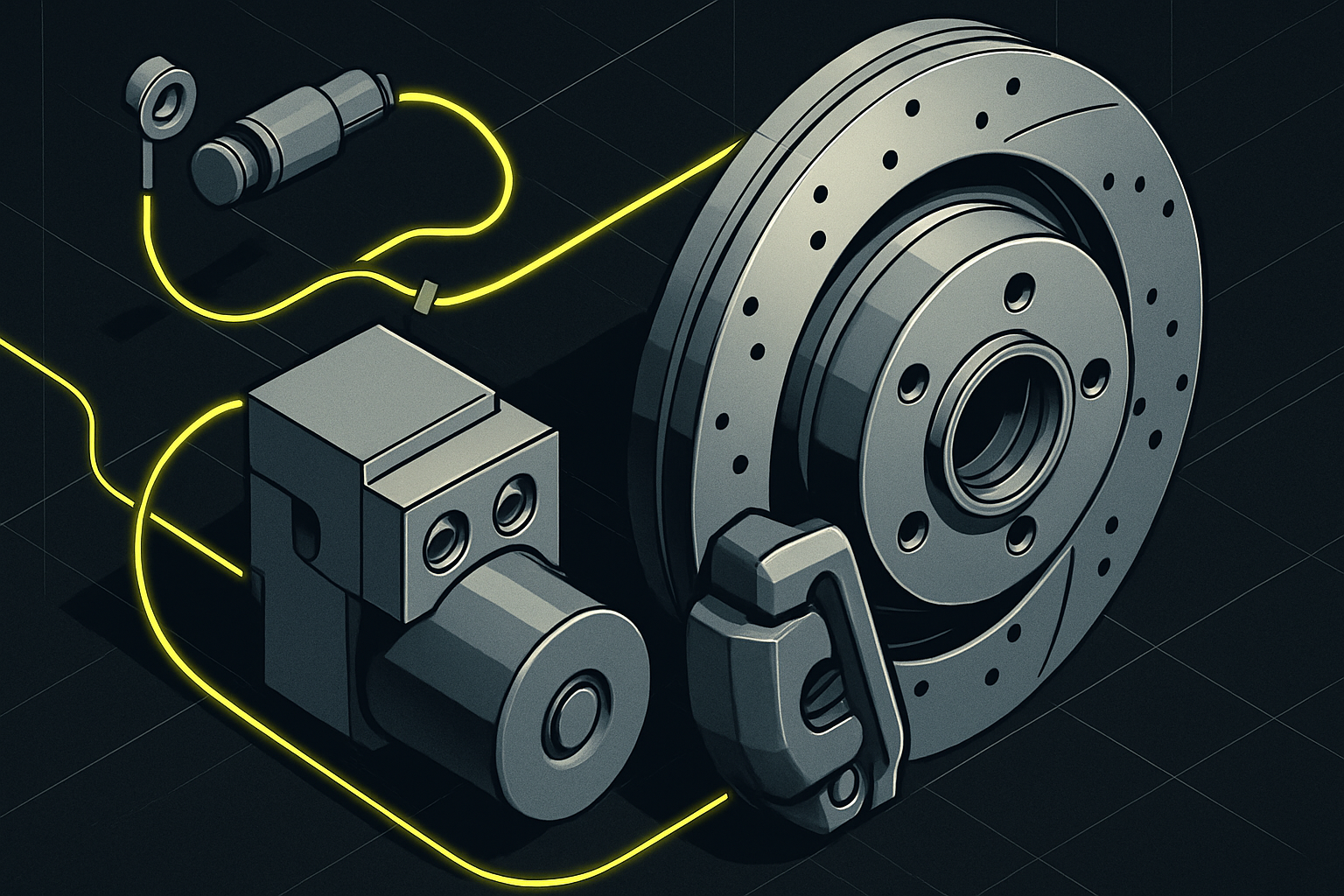
The ABS system consists of several elements working in close coordination. Wheel speed sensors (also known as ABS sensors or reluctor sensors) measure the rotational speed of each wheel in real time. They read the teeth of the ABS ring, a toothed crown mounted on the wheel hub or integrated directly into the brake disc. Any sudden change in rotational speed alerts the control module that the wheel is close to locking.
The hydraulic control unit (HCU) is the mechanical heart of the system. It contains solenoid valves that independently open or close the brake fluid flow to each calliper, along with a return pump that feeds fluid back into the circuit when pressure is released. This entire process repeats between 10 and 15 times per second per wheel, producing the characteristic pedal pulsation the driver feels when ABS activates.
The ABS electronic control module (ECU) processes signals from all four sensors and decides within milliseconds which valves to actuate. For its calculations to be accurate, the physical components of the system must be in good condition. A disc with a worn ABS track or a rubber hose with excessive expansion introduces noise into the hydraulic circuit that can result in erratic or delayed ABS activation. Replacing rubber hoses with non-expandable braided hoses and fitting precision brake discs with a well-machined ABS ring directly improves the effectiveness of the ABS module.
ABS in practice: from daily driving to circuit use
In everyday driving, ABS mainly activates during emergency stops caused by unexpected hazards: a pedestrian stepping out, a vehicle braking sharply ahead, or a wet road surface with reduced grip. The driver does not need to do anything special — simply press the brake pedal as firmly as possible and hold it down while ABS manages the pressure automatically.
In sports and trackday driving, the relationship with ABS becomes more technical. On circuit, a well-calibrated ABS system fed by highly responsive components allows the driver to brake later and with greater confidence, knowing the system will prevent lock-up even at the limit. Here, brake fluid quality becomes critical: a synthetic DOT4 fluid with a high dry boiling point keeps hydraulic pressure stable even as the circuit heats up during long sessions, ensuring the ABS module continues to receive clean hydraulic signals throughout.
In rally and motorsport, teams often use more sophisticated ABS systems with adjustable maps for different surface types. Even so, the physical foundation of the system — discs with precisely engineered rings, hoses with no expansion, and high-spec fluid — remains decisive. Motorsport brake discs with Cut-Moon slots, for example, improve gas and pad material evacuation, reducing the risk of brake fade and maintaining consistent ABS sensor signal quality throughout an entire stage or session.
ABS system maintenance: common mistakes and best practices
The most common maintenance mistake with ABS is forgetting that the system depends on the health of the entire braking circuit, not just the electronic module. Fitting new brake discs without checking that the replacement includes a compatible ABS ring, or swapping a rubber hose without inspecting the condition of the banjo fitting, can trigger the ABS warning light without any actual electronic fault being present.
Another widespread error is mixing brake fluids of different specifications or brands when bleeding the system. DOT4 synthetic brake fluid must be fully replaced, not simply topped up, because aged fluid absorbs moisture and its boiling point drops. This can generate vapour bubbles in the hydraulic circuit during hard stops, directly affecting the pressure modulation managed by the ABS.
For correct maintenance: visually inspect the ABS rings every time you change the discs, replace brake fluid every two years or sooner if the vehicle is used on track, and consider upgrading rubber hoses to braided metal hoses when they approach 80,000 km or show any sign of deterioration. These three straightforward actions have the greatest real-world impact on ABS effectiveness at the moment it is needed most.
An ABS system is only as effective as the physical components surrounding it. Precision brake discs with ABS rings, non-expandable braided hoses, and high-spec DOT4 brake fluid form the foundation on which the electronic module operates. At SDT Brakes you will find all of these components with own-brand manufacture, specialist technical advice, and 24-48h shipping across mainland Spain.
Frequently asked questions
What is ABS and what does it actually do in a vehicle?
ABS (Antilock Braking System) is an electronic safety system that automatically regulates hydraulic pressure at each brake calliper to prevent wheel lock-up during heavy braking. By preventing lock-up, the driver retains steering ability, reducing stopping distances and maintaining vehicle control in emergency situations on most road surfaces.
Are brake discs with an ABS ring better than standard discs?
Discs with an integrated ABS ring ensure the wheel speed sensor receives a clean, continuous signal — particularly important after fitting larger-diameter discs. A quality disc with a precisely machined ABS track prevents false ABS activations and keeps the control module calibrated correctly, which is essential for reliable performance under hard braking.
Can braided brake hoses affect how the ABS works?
Far from harming it, non-expandable braided hoses improve the hydraulic response of the braking circuit, delivering more linear pressure modulation right in the ABS operating range. By eliminating the expansion of a rubber hose, the system receives pressure more consistently, allowing the ABS module to intervene with greater precision and repeatability.
How often should brake fluid be changed on a vehicle with ABS?
DOT4 synthetic brake fluid absorbs moisture over time, lowering its boiling point and potentially affecting ABS response during hard stops. It is recommended to replace it every two years or every 40,000 km, or sooner if the vehicle is used on track. Degraded fluid can generate vapour in the ABS hydraulic circuit, causing a soft pedal and inconsistent system response.
Does ABS work differently in wet conditions compared to dry?
In wet conditions, ABS delivers an even greater benefit because grip levels are lower and the risk of lock-up is significantly higher. On dry tarmac or wet asphalt, ABS consistently improves both control and safety. On loose gravel or deep snow, some systems may slightly increase stopping distance compared to a locked-wheel stop, though steering control is always preserved.
Can ABS be disabled for circuit driving or rally use?
Some competition vehicles allow ABS to be deactivated so the driver can manually manage the lock-up threshold. However, this is neither recommended nor road-legal on standard road cars. For trackday use with ABS active, the key is fitting high-performance discs, brake pads, and braided hoses that maximise the precision and response of the system throughout the session.
Why SDT Brakes?
Own manufactureAll SDT components are manufactured and validated in Europe to motorsport standards.
ABS compatibilityOur discs and hoses are designed to respect original ABS rings and wheel speed sensors.
Technical supportA team of brake specialists advises you before and after purchase, at no charge.
Fast delivery24-48h delivery to mainland Spain so you do not lose a single day on the road or track.
Top-ratedOver 480 verified reviews with an average rating of 4.8 out of 5 confirm our quality.
Easy returns14 days to return any product, no questions asked and no complications.
Upgrade your ABS system with precision components from SDT Brakes
Whether you need discs with an integrated ABS ring, braided hoses for immediate hydraulic response, or high-spec DOT4 brake fluid, SDT Brakes has the right technical solution for your vehicle. Own EU manufacture, 24-48h shipping, and specialist advice included at no extra cost.
Updated: 20 June 2026