 Español
 English
Shopping Cart
⭐ 4.8/5 (480 verified reviews)24–48h delivery to mainland SpainOwn EU manufacturingFree technical advice
SDT Brakes
ABS Braking: How It Actually Works on the Road
The ABS system is now a standard active safety feature on virtually every modern vehicle, yet few drivers truly understand what happens inside the system during an emergency stop. Knowing how it works in practice allows you to make the most of it and keep it in peak condition.
In this technical guide from SDT Brakes, we break down the complete ABS cycle — from wheel lock detection to hydraulic pressure modulation — and explain the role each brake circuit component plays in the system's overall effectiveness.
⭐ 4.8+480 valoraciones
verificadas
verificadas
Genuine technical contentno oversimplifications or empty theory
Covers car, motorbike and kartall vehicle types in the SDT catalogue
Practical focuswhat to feel when driving and when to inspect the system
Linked to maintenancewhich components directly affect ABS performance
Which part of your brake system do you want to upgrade today?
How Does Each Component Affect ABS Performance?
| Model | Role in ABS | Key benefit | Vehicle type | Improvement level |
|---|---|---|---|---|
| Braided lines BMW Series 2 F22 | Pressure transfer without expansion | Immediate pedal response | High-performance car | High |
| Braided lines VW Golf VI RTop choice | Non-extensible line for precise signal | Firm pedal during ABS cycles | Sports / GTI car | High |
| Braided lines Toyota Celica ZZT230 | Eliminates OEM hose flex | Consistent feel in repeated braking | Sports saloon | Medium-high |
| DOT4 synthetic fluid 1L | Hydraulic medium for ABS modulator | Stable boiling point (dry 240°) | Universal car/bike | Essential |
| Cut Moon discs with ABS ring Megane RS | Integrated wheel-speed signal source | No signal loss with sports disc | Competition saloon | High |
| Twin pack DOT4 (2x 450ml) | Full circuit fluid renewal | Prevents vapour lock in long ABS events | Workshop / fleet | Essential |
What Is ABS and Why Did It Transform Active Safety?
The Anti-lock Braking System — universally known as ABS — is an active safety device that prevents the complete lock-up of wheels during heavy braking. When a wheel locks, the tyre transitions from rolling contact to sliding, which eliminates steering ability and, on most surfaces, increases stopping distance. ABS intervenes to keep each wheel at the threshold between rolling and sliding, where the tyre generates its maximum friction force.
Developed industrially in the late 1970s and fitted to mainstream passenger cars from the 1980s onward, ABS evolved from an exclusive feature on premium saloons to a mandatory fitment under European type-approval regulations. Today it forms the foundation on which more complex systems are built: electronic stability control (ESC), traction control (ASR) and autonomous emergency braking (AEB) all depend on a fully functional ABS unit to operate correctly. Without reliable ABS, none of those systems can deliver their intended benefit.
The fundamental advantage of ABS is speed and precision. A modern system can open and close the hydraulic valves on each individual wheel between 10 and 20 times per second — far beyond any driver's physical capability with the pedal. This maintains wheel slip within the optimal friction range regardless of how forcefully the driver presses the brake, making consistent maximum deceleration accessible to every driver in any emergency.
How ABS Works Step by Step: Sensors, ECU and Hydraulic Modulator
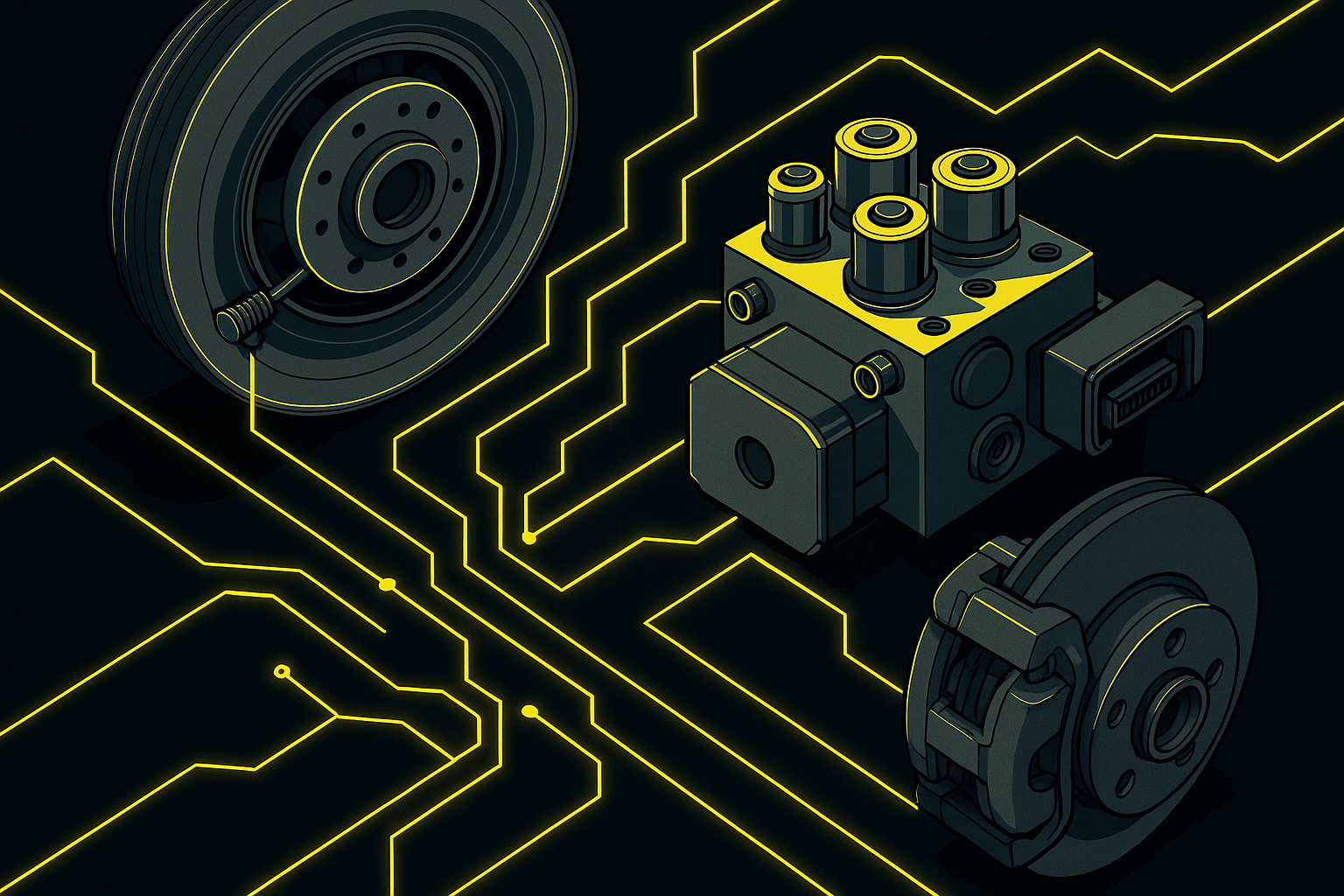
The ABS system comprises four main elements working in a continuous cycle during every active braking event. The first are the wheel speed sensors, typically inductive or Hall-effect devices mounted at the hub or disc via a toothed ring known as the ABS tone ring or reluctor ring. Each sensor sends the ECU a frequency signal proportional to that wheel's rotational speed. When one wheel begins decelerating faster than the others, the ECU detects the anomaly within milliseconds.
The second element is the electronic control unit (ECU), which continuously compares all four wheel speeds and calculates each wheel's deceleration rate. When it detects that a wheel is approaching lock-up, it sends a modulation command to the third component: the hydraulic control unit (HCU). This block contains inlet and outlet solenoid valves for each brake circuit, plus a return pump that feeds fluid back into the system during pressure reduction phases.
The modulation cycle follows three phases repeated in rapid succession. During the hold phase, the inlet valve closes to isolate the wheel cylinder from pedal pressure. During the reduce phase, the outlet valve opens and fluid moves into an accumulator, lowering caliper pressure and allowing the wheel to spin up again. During the increase phase, both valves return to their default positions and the pump restores pressure. This cycle repeats continuously until the wheel's deceleration normalises or the vehicle stops — the driver experiences this as the characteristic pulsation felt through the brake pedal.
ABS in Practice: How to Drive With It and Where Its Limits Lie
The most common mistake when first experiencing ABS activation is to release the brake pedal as soon as the pulsations begin. This immediately cancels the system's intervention and returns full responsibility to the driver, eliminating both the stopping distance benefit and the retained steering capability. The correct technique is to apply and maintain maximum pedal force — sometimes described as threshold braking with ABS assistance — and allow the ECU to handle modulation. The steering wheel remains fully responsive throughout, enabling the driver to steer around an obstacle whilst braking at maximum force.
On homogeneous surfaces such as dry or wet tarmac, ABS delivers its best results: directional control is preserved and stopping distances approach the theoretical friction limit for the tyre. On mixed surfaces — for example a lane that transitions from ice to asphalt — the ABS may apply different logic depending on system generation. Older select-low systems use the lower-grip wheel as the reference for both wheels on an axle, while more advanced individual wheel control systems can apply independent pressure to each corner for a more optimised result.
Drivers who use their vehicles for trackdays or circuit driving should be aware that standard OEM ABS calibration is set for public road use, with conservative lock-up thresholds. On track, maximum braking performance may benefit from upgraded brake components — braided steel brake lines, high-boiling-point synthetic DOT4 fluid and high-performance brake pads — which allow the OEM ABS to operate closer to its potential without compromising road safety on the return journey home.
ABS Maintenance: What to Check and Common Mistakes to Avoid
ABS is a combined electronic and hydraulic system, and its degradation can be gradual and silent until the dashboard warning light illuminates. Preventive maintenance focuses on four concrete areas. The first is brake fluid: DOT4 fluid absorbs moisture over time, which progressively lowers its boiling point. During intense ABS cycles, degraded fluid can vaporise inside the modulator block, creating compressible gas bubbles and erratic pressure behaviour. Periodic bleeding of the entire circuit — including the ABS modulator itself — is essential. A quality synthetic DOT4 fluid with a high dry boiling point is the correct choice for any vehicle where the ABS system may be called upon in demanding conditions.
The second area is the ABS tone ring and wheel speed sensors. The tone ring can accumulate dirt, rust or suffer mechanical damage, generating erratic or intermittent signals that cause false activation or full system deactivation. Cleaning the sensor tip and inspecting the tone ring during every disc change costs little time and avoids unexpected failures. Disc assemblies that include an integrated ABS ring — such as those offered by SDT Brakes for specific applications — simplify this by renewing both elements simultaneously.
The third area is the brake hose condition. An aged rubber hose can swell internally, creating a dead volume that the ABS modulator must compensate for with additional pump cycles, reducing overall modulation efficiency. Upgrading to stainless steel braided brake lines eliminates that variability. The most common oversight in routine servicing is concentrating exclusively on pads and discs while ignoring the hoses entirely. Finally, the wiring and connectors of all four wheel speed sensors deserve periodic visual inspection, particularly on vehicles regularly exposed to road salt or mud.
Understanding how ABS braking works in depth is the first step towards keeping the system at full performance. The second step is ensuring that every component in the hydraulic chain — fluid, brake lines, discs and sensors — meets the same standard. At SDT Brakes you will find everything you need, with specialist technical advice included and delivery across mainland Spain within 24–48 hours.
Frequently asked questions
What does the driver feel when ABS activates during braking?
When ABS activates, the driver feels a rapid pulsation or vibration through the brake pedal, often accompanied by a fast clicking sound. This is entirely normal: it means the modulator is opening and closing the hydraulic valves multiple times per second to prevent wheel lock. The correct response is to maintain maximum pedal pressure and allow the system to manage modulation — releasing the pedal defeats the purpose of the system entirely.
Does ABS always shorten stopping distances?
Not on every surface. On dry or wet tarmac, ABS achieves stopping distances similar to or shorter than a locked wheel whilst preserving steering control. On loose gravel or deep snow, however, a locked wheel can build a wedge of material that aids braking, meaning ABS may not reduce distance in those conditions. For all normal road use, ABS is consistently beneficial both for distance and directional control during emergency stops.
What role does brake fluid play in ABS operation?
Brake fluid is the hydraulic medium that transmits pressure from the pedal through the ABS modulator to the caliper pistons. If the fluid has absorbed moisture over time, its boiling point drops significantly. During rapid ABS cycles, localised heat can vaporise degraded fluid and create compressible gas bubbles, leading to a spongy pedal and inconsistent modulator response. Using a synthetic DOT4 fluid with a high dry boiling point ensures the modulator operates consistently even during prolonged braking events.
Do braided steel brake lines improve ABS response?
Yes, indirectly but meaningfully. Standard rubber hoses expand slightly under pressure, introducing a small delay between the ABS modulator's command and the actual pressure change at the caliper. Replacing them with stainless steel braided lines — which are virtually non-extensible — means the modulator's rapid pressure adjustments translate far more directly to each wheel. The practical result is a firmer, more communicative pedal and more efficient modulation cycles.
How often should the ABS system be inspected?
ABS maintenance should be included in every routine service. Key checks are: brake fluid condition and boiling point (bleed every two years as a general guideline), visual inspection of wheel speed sensors and their wiring harnesses, verification that the ABS tone ring on each disc is undamaged and clean, and assessment of brake hose condition. An illuminated ABS warning light on the dashboard should always be diagnosed promptly rather than ignored.
Does ABS work the same way on motorcycles as on cars?
The underlying principle is identical, but the implementation differs. On a motorcycle, ABS manages two independent circuits — front and rear — and advanced systems add cornering ABS, which adjusts modulation thresholds based on lean angle. Some systems also feature combined braking, distributing force between both axles when only one brake is applied. The activation thresholds and algorithms vary considerably by manufacturer and selected riding mode.
Why SDT Brakes?
Own manufacturingBrake lines and discs manufactured in Europe to motorsport standards.
24–48h dispatchOrders reach mainland Spain in one working day, ready to fit.
Technical supportOur specialists answer ABS compatibility questions at no charge.
4.8/5 ratingOver 480 verified reviews from private customers and professional workshops.
Easy returns14-day no-quibble returns if the product does not meet your needs.
Give Your ABS System the Components It Deserves
Effective ABS relies on the entire hydraulic chain: fresh fluid with a high boiling point, brake lines that do not yield under pressure, and discs with an intact ABS tone ring. At SDT Brakes you will find every one of those components, backed by European manufacturing standards and delivered within 24–48 hours. Reach out to our technical team and upgrade your system with confidence.
Updated: 20 June 2026