 Español
 English
Shopping Cart
⭐ 4.8/5 (480 verified reviews)24–48h delivery, mainland SpainOwn EU manufacturingFree technical advice
SDT Brakes
ABS System in a Car: Components and How It Works Explained
The ABS (Antilock Braking System) is one of the most important active safety innovations in automotive history. It allows the driver to maintain steering control during emergency braking by preventing wheel lock-up, dramatically reducing stopping distances on most surfaces.
In this technical guide from SDT Brakes, we cover everything you need to know: what ABS is, how each component works, its real-world applications, and how to keep the system in top condition throughout the life of your vehicle.
⭐ 4.8+480 valoraciones
verificadas
verificadas
Full controlABS prevents wheel lock-up during emergency braking
CompatibilitySDT Brakes discs and pads are designed to work with ABS systems
EU manufacturingevery SDT Brakes component is made and validated in Europe
Technical supportexperts who understand every sensor and actuator in the system
Which brake system component do you need to upgrade?
Which to choose? Comparison of ABS-compatible brake components
| Model | Type | ABS Compatibility | Recommended Use | Highlight |
|---|---|---|---|---|
| Cut Moon Discs Ø290 Megane III RS (with ABS ring)Top choice | Slotted rear disc | Includes ABS ring | Sport / road | Integrated ABS ring |
| S50+ Pads BMW M2 G42 M3 G20 M4 G22 Front | Front brake pad | Full, no interference | Sport / track | High carbon-fibre content |
| S50+ Pads Tesla Model 3 / Model Y Front | Front brake pad | Full, no interference | EV / urban-sport | Low dust, regenerative-friendly |
| S50+ Pads Mercedes C 63 AMG Rear | Rear brake pad | Full, no interference | GT / high performance | Extreme heat resistance |
| Braided Brake Lines Alfa Romeo Giulia GTA QV | Braided brake line | Full, no interference | Supercar / track | Immediate pedal response |
| Braided Brake Lines Fiat Ducato Motorhome | Flexible braided line | Full, no interference | Heavy vehicle / camper | Enhanced safety under load |
What is ABS and why is it mandatory on modern cars?
The ABS, or Antilock Braking System, automatically regulates hydraulic brake pressure at each wheel during emergency braking to prevent lock-up. Originally developed for aircraft in the 1950s and adapted for road vehicles during the 1970s, it became mandatory on all new passenger cars sold in the European Union from 2004 onwards.
The importance of ABS is rooted in a fundamental physics principle: a rolling wheel with grip generates greater braking force than a fully locked, sliding wheel. Furthermore, a locked wheel loses all capacity to generate lateral force, meaning the driver cannot steer around an obstacle no matter how sharply they turn the steering wheel. ABS solves both problems by modulating brake pressure in rapid pulses — typically between ten and fifteen times per second.
Beyond active safety, ABS is the foundation on which more advanced systems are built: ESP (Electronic Stability Programme), traction control (TCS) and electronic brake-force distribution (EBD) all depend on a correctly functioning ABS system. Without a well-calibrated ABS and components in good condition, all these secondary systems lose effectiveness or simply cannot operate as designed. This is why the condition of the brake discs, pads and wheel speed sensors is so important in any modern vehicle.
ABS components: how they work together during a braking event
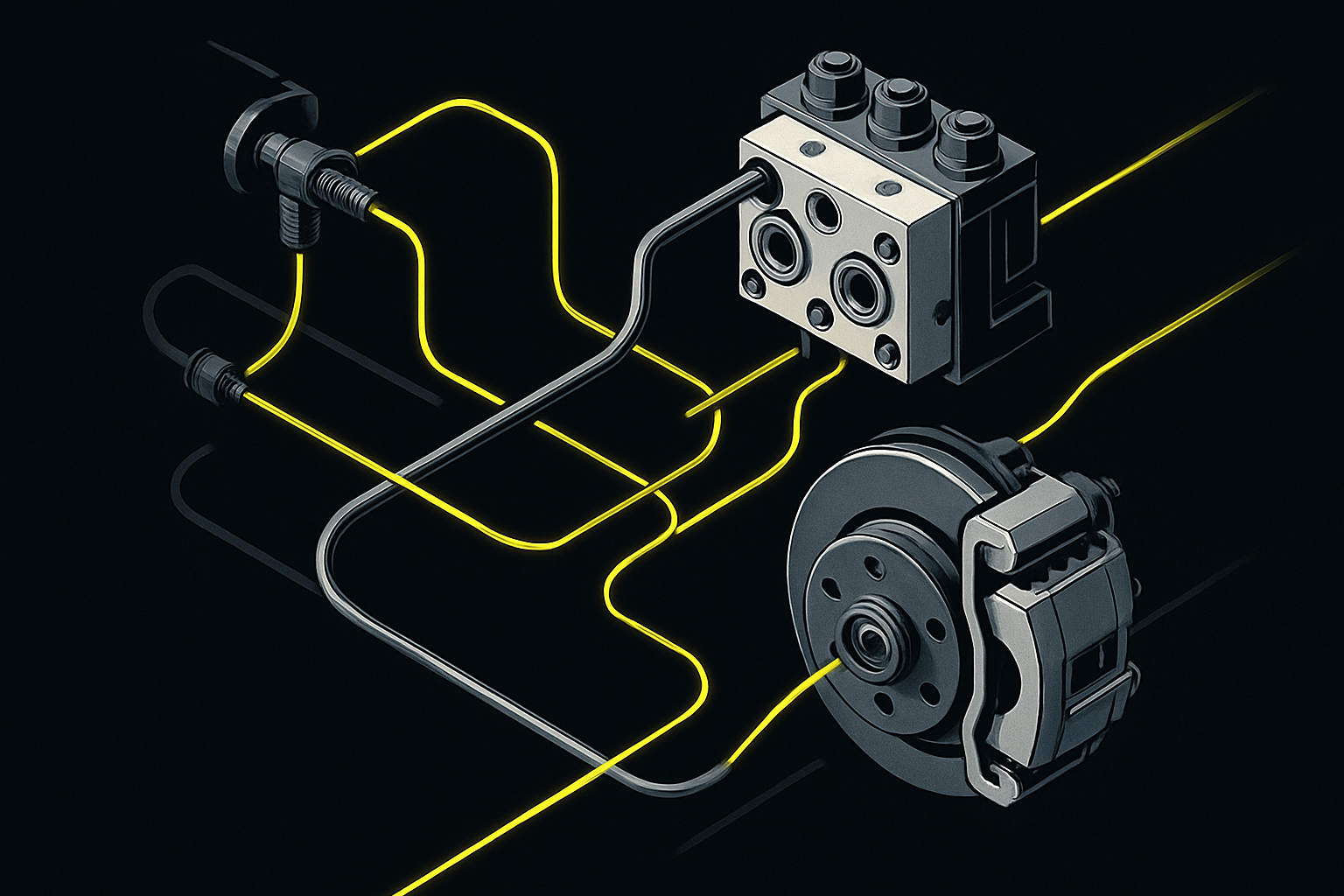
The ABS system is built around four components that act in coordinated fractions of a second. The first are the wheel speed sensors, one per wheel, which continuously send electrical signals to the control unit reporting the rotational speed of each wheel independently. These sensors can be passive (inductive) or active (Hall-effect), the latter being more accurate at very low speeds and the standard on most modern vehicles.
The second key component is the reluctor ring (also called the ABS tone ring), which is fixed to the wheel hub or integrated into the rear brake disc. This ring is what the sensor reads: each tooth that passes the sensor generates an electrical pulse. If the sensor detects that a wheel is decelerating abnormally fast compared to the others — a clear sign of imminent lock-up — it sends that data to the ABS electronic control unit (ECU), the third component, which processes the information in real time and issues the corrective response.
That response is executed by the fourth component: the hydraulic control unit (HCU). This block contains solenoid inlet and outlet valves plus a small electric pump. On receiving the ECU's command, the valves reduce, hold or restore pressure in the brake circuit of the affected wheel in rapid cycles that the driver feels as a pulsation through the brake pedal — a perfectly normal and reassuring sign that the system is actively working.
The quality of brake discs and pads directly affects ABS efficiency. A disc with surface runout or a deteriorated reluctor ring sends incorrect readings to the ECU, causing premature or delayed system activation. Equally, high-performance brake pads with a higher friction coefficient allow maximum advantage to be taken of each ABS modulation cycle, shortening stopping distances.
Practical applications of ABS: when it activates and what difference it makes
The ABS intervenes exclusively when it detects the imminent lock-up of one or more wheels. Under normal braking conditions the system remains completely inactive, with the driver in full control of hydraulic pressure. Only during hard braking — whether from an emergency, excess speed in a corner, or a low-grip surface — does the ECU take partial control of pressure in the affected circuit.
The most common situations in which ABS proves decisive are: emergency stops at high speed on a straight, braking mid-corner where weight transfers to the outside wheels, split-mu surfaces (one wheel on dry tarmac and another on gravel or ice), and braking on steep downhill sections. In all these scenarios, ABS ensures the driver can continue steering around obstacles while braking, something physically impossible with locked wheels.
From a performance driving perspective, it is worth understanding that standard OEM ABS is not always optimal for track use. On circuit, skilled drivers can sometimes modulate the brakes more precisely than certain road-spec ABS calibrations. However, many high-performance cars now feature adjustable or track-disengageable ABS maps. In those cases, fitting competition-grade brake pads such as the SDT Brakes Racing RT-66 or RS-55 range — compounds developed specifically for trackday and off-road use — allows the driver to extract maximum performance from whichever ABS setting they select.
For everyday road use, the most important interaction a driver has with the ABS is indirect: regular maintenance of the brake system components. A set of discs and pads in good condition gives the ABS a solid mechanical foundation to work from. If discs have worn below minimum thickness or pads have reached the wear limit, ABS effectiveness is compromised regardless of how sophisticated the electronics are.
ABS maintenance: common mistakes and how to avoid them
Preventive ABS maintenance starts with regular inspection of the mechanical brake components: discs, pads, brake lines and brake fluid. A warped or heavily corroded brake disc can cause fluctuations in wheel speed sensor readings even when the reluctor ring is intact, triggering ghost ABS activation. Braided stainless steel brake lines, replacing the original rubber hoses, reduce line expansion under pressure and offer a more predictable response from the hydraulic modulator.
The reluctor ring deserves specific attention every time work is carried out on the wheel hub or rear discs. A single broken tooth or compacted dirt build-up on the ring can produce exactly the same fault symptoms as a defective sensor. Before replacing a wheel speed sensor, always clean and inspect the corresponding reluctor ring carefully.
Brake fluid is another critical and often underestimated factor. Brake fluid absorbs moisture over time and its boiling point drops as a result, which can cause vapour to form in the circuit during intense braking. When this occurs, the hydraulic modulator cannot compress the vapour in the same way it compresses fluid, losing effectiveness at precisely the moment the ABS is working hardest. The general recommendation is to change the brake fluid every two years, or more frequently if the vehicle is used on track or in spirited driving conditions.
Finally, whenever the ABS warning light illuminates on the instrument cluster, the recommended first step is to connect a diagnostic scanner to identify the exact fault code before replacing components blindly. At SDT Brakes we offer a free technical advice service to help workshops and private customers identify the root cause and choose the most suitable brake components for their specific vehicle and use case.
The ABS system is only as effective as the quality of the components it works with. Properly dimensioned discs, pads with the right compound and brake lines that faithfully transmit hydraulic pressure are the foundation of a safe and predictable braking system. At SDT Brakes you will find everything you need to maintain or upgrade your brakes, backed by European quality assurance.
Frequently asked questions
What does ABS mean in a car and what exactly does it do?
ABS stands for Antilock Braking System. Its primary function is to prevent the wheels from locking up during hard braking, allowing the driver to maintain steering control and reduce stopping distances on most surfaces. It has been mandatory on all new cars sold in the EU since 2004.
What are the main components of a car's ABS system?
The ABS system consists of four key elements: the wheel speed sensors (one per wheel), the electronic control unit (ABS ECU), the hydraulic control unit (HCU) with its solenoid valves and pump, and the reluctor ring (ABS tone ring) attached to the wheel hub or rear disc. All four work in coordinated millisecond cycles during braking.
How does the brake disc affect the proper functioning of the ABS?
The ABS reluctor ring is often integrated into the wheel hub or the rear brake disc assembly. A warped, excessively corroded disc or a ring with broken teeth can cause the sensor to read incorrect signals, triggering premature or delayed ABS activation. Choosing quality discs with intact ABS rings is therefore essential for reliable system performance.
Can I improve braking performance without disabling the ABS?
Absolutely. Fitting high-performance pads such as the SDT Brakes S-50+ range, or installing braided brake lines, significantly improves pedal feel and braking power without interfering with the ABS in any way, provided the components are road-legal and compatible with your vehicle's specifications.
Why does the ABS warning light come on in the dashboard?
The ABS warning light can illuminate for several reasons: a dirty or faulty wheel speed sensor, a reluctor ring with broken teeth, a fault in the hydraulic modulator, low brake fluid level, or an electrical wiring issue. Always scan for fault codes before replacing parts, as the root cause is not always the sensor itself.
Why SDT Brakes?
Own manufacturingEvery SDT Brakes component is manufactured and validated at our European facilities.
Technical supportOur team answers any question about ABS compatibility with your specific vehicle.
Fast shipping24–48h delivery across mainland Spain so you don't wait to brake better.
Satisfied customersAverage rating of 4.8/5 among private drivers, workshops and professional racers.
Easy returns14-day hassle-free returns if the product is not exactly what you needed.
Upgrade your braking system with SDT Brakes components
SDT Brakes offers a full range of brake pads, discs, braided lines and accessories engineered to work in perfect harmony with your vehicle's ABS system. European quality, 24–48h dispatch and expert technical support included with every order.
Updated: 20 June 2026