 Español
 English

Shopping Cart
⭐ 4.8/5 (480 verified reviews)24–48h dispatch mainland SpainEU own manufactureFree technical advice
SDT Brakes
Worn Brake Discs: Symptoms and When to Replace Them
Brake discs are safety-critical components. As they wear, braking performance deteriorates gradually — sometimes imperceptibly — until it becomes a genuine hazard. Spotting the warning signs early can make all the difference.
At SDT Brakes, we answer the most common questions about brake disc wear: what symptoms to look for, how often to inspect them, and which replacement options are available for everyday, sports or competition use.
⭐ 4.8+480 valoraciones
verificadas
Free technical advicebrake specialists on hand at no extra cost
European own manufacturediscs produced with premium-grade steel
24–48h dispatchfast delivery across mainland Spain and the EU
Full cataloguediscs for cars, motorbikes, karts and special vehicles
What symptom are you noticing with your worn brake discs?
Which to choose? Comparison by wear level and use
| Model | Slot type | Recommended use | Includes ABS/bearing | Performance level |
|---|---|---|---|---|
| Standard replacement disc | Plain | Daily urban use | Model dependent | Basic |
| Slotted sports disc | Classic slotted | Spirited road & circuit | Not included | High |
| SDT Brakes Cut-Moon discTop choice | Specific Cut-Moon | Sports / competition | Yes (bearing + ABS) | Very high |
| SDT Racing brake ring | Ventilated racing | Competition only | Not included | Competition |
| Drilled and slotted disc | Drilled + slotted | Trackday & mixed use | Reference dependent | High–Competition |
Why brake discs wear and what accelerates the process
Brake discs work through friction: every time you press the pedal, the brake pads clamp against the disc surface, converting kinetic energy into heat. Repeated thousands of times, this process gradually erodes the disc material. Factors such as vehicle weight, driving intensity, pad quality and type of use — urban, motorway or circuit — all determine how quickly that wear occurs.
Urban driving with frequent low-speed stops produces steady, uniform wear. Conversely, hard braking from high speed generates temperature spikes that can cause localised distortion and accelerate disc deterioration. Drivers who combine road use with track days or spirited driving should therefore inspect their discs more regularly than the average user, and consider performance-oriented replacements from the SDT Brakes catalogue.
When to replace brake discs: technical and legal criteria
Road worthiness regulations require that disc thickness remains above the manufacturer's stated discard limit, which is stamped on the disc edge. Falling below that figure renders the component unfit for road use. In practice, performance is compromised well before that legal threshold is reached: a disc close to its minimum thickness dissipates heat poorly, warps more easily and increases stopping distances measurably.
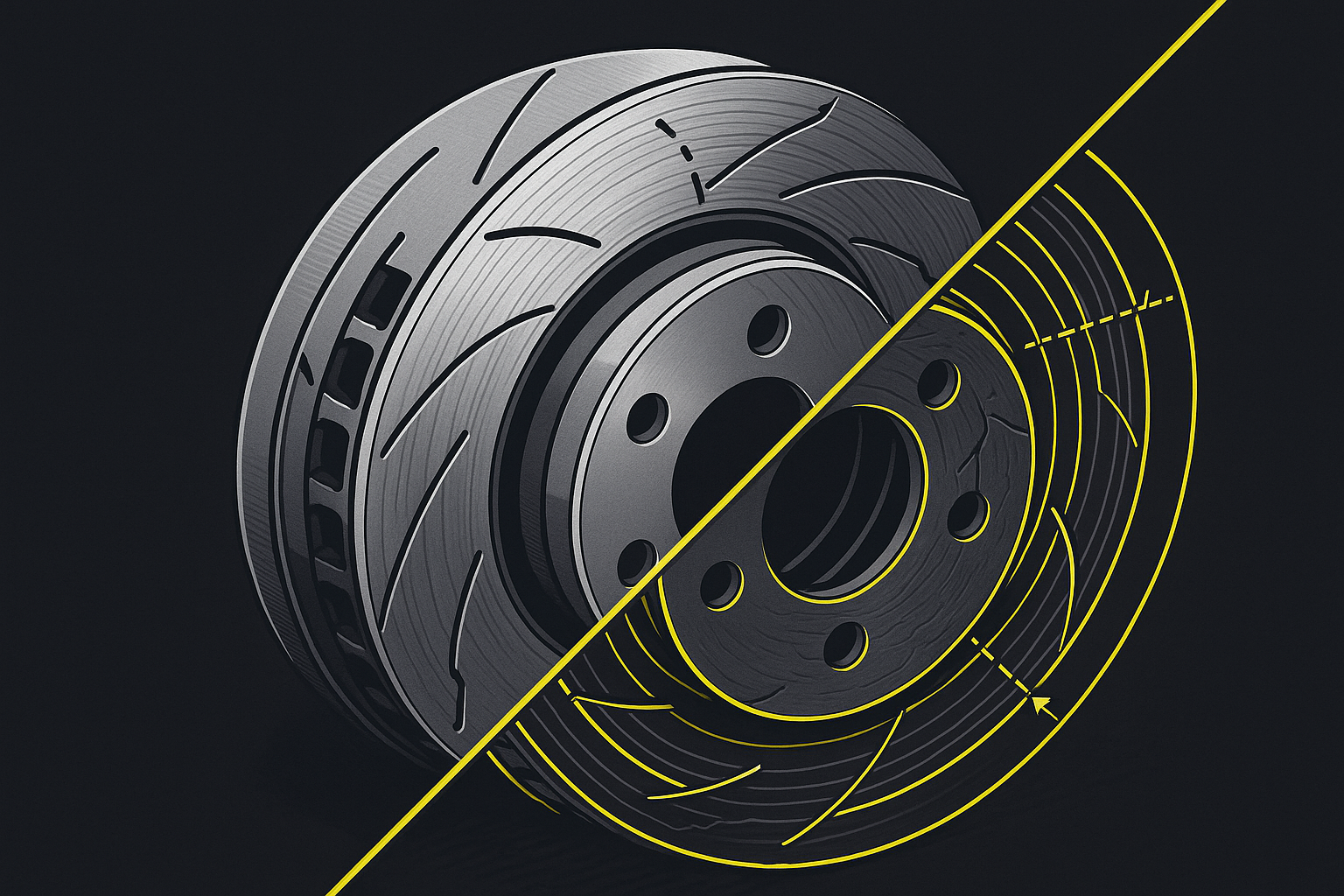
As a practical guideline, replace discs when they show grooves deeper than approximately 1.5 mm, when a pronounced lip is visible at the outer edge of the friction surface, or when signs of surface cracking appear. Vehicles used in competition or on track should be serviced at considerably shorter intervals than standard road cars. The SDT Brakes range includes sports and competition brake discs for every requirement, backed by free specialist advice on every order.
SDT Brakes is a European brand specialising in high-performance braking systems. All our brake discs are produced under our own quality control process using selected steels and surface treatments that maximise service life. More than 480 customers have rated our products 4.8 out of 5. We offer 24–48h dispatch to mainland Spain and free technical advice to help you choose the right disc for your vehicle and driving style.
Frequently asked questions
What are the clearest signs that brake discs are worn?
The most common symptoms include vibration or pulsation through the brake pedal, sharp metallic squealing or grinding noises, longer stopping distances, visible grooves or scoring on the disc surface, and the brake warning light illuminating on the dashboard. Any of these signs warrants an immediate inspection of the braking system.
How often should brake discs be checked?
As a general guideline, brake discs should be inspected every 20,000–30,000 km or at every annual service. The actual rate of wear depends on driving style, vehicle weight and the quality of the brake pads fitted. Drivers who use their vehicles on track or in spirited driving should inspect their discs more frequently — sometimes at the end of every season or event.
What is the minimum safe thickness for brake discs?
Every disc has a minimum service thickness stamped on its edge or specified by the manufacturer. Once a disc reaches this limit, heat dissipation becomes inadequate, the risk of warping increases and braking efficiency drops significantly. As a practical rule, if the disc has lost more than 2–3 mm compared to its nominal thickness, it must be replaced immediately.
Do brake discs and pads always need to be replaced together?
Not always, but it is strongly recommended. Brake pads bed into the existing disc profile, and fitting new pads onto heavily worn discs results in uneven contact and a longer bedding-in period. If the discs are near their wear limit, replacing both components at the same time ensures consistent braking performance and extends the service life of both parts.
Can brake discs be damaged without high mileage?
Yes. Discs exposed to moisture during prolonged periods of inactivity can develop surface corrosion. In most cases this rust disappears after the first few firm brake applications, but if corrosion is deep or the disc has been stationary with pads in contact for an extended period, permanent marking may result, causing vibration and requiring replacement.
What is the difference between a worn disc and a warped one?
A worn disc has lost thickness uniformly or shows friction grooves from continuous use. A warped disc has suffered geometric deformation, usually through overheating or rapid cooling. The telltale sign of warping is a rhythmic, very noticeable pulsation through the pedal under braking. Both conditions are equally dangerous and require disc replacement.
Do sports or slotted brake discs wear out faster than standard ones?
It depends on use. Slotted or Cut-Moon discs offer better evacuation of gases and brake dust, improving braking under demanding conditions, but in purely urban, low-intensity driving the wear rate can be marginally higher than a plain disc. For mixed or sports use, the performance and durability benefits far outweigh that marginal difference.
How can I check my brake disc condition at home?
With the vehicle parked and cold, inspect the disc visually through the wheel spokes: look for deep grooves, blue-tinted zones from excessive heat, or a pronounced lip at the outer edge. You can also measure the disc thickness with a micrometre at several points and compare the result against the manufacturer's minimum. If in doubt, have the system checked by a qualified specialist.
Why SDT Brakes?
Own manufactureDiscs designed and made in Europe under our own quality control standards.
Express dispatchReceive your new discs in 24–48 hours anywhere on the Spanish mainland.
Technical adviceOur brake specialists help you choose the right disc for your vehicle.
Top-rated brandOver 480 verified reviews with an average score of 4.8 out of 5.
Easy returns14-day hassle-free returns if the product does not suit your needs.
Racing heritageProducts tested in real competition and adapted for road use too.
Replace worn discs with the SDT Brakes guarantee
A braking system in perfect working order is priceless. At SDT Brakes you will find brake discs for every application, manufactured to European quality standards, with express dispatch and a dedicated technical team ready to ensure you always choose the right component for your vehicle.
Updated: 20 June 2026